PLAY Ransomware : Le gang de la double extorsion
Table des matières
Le ransomware Play a été l’une des opérations de ransomware les plus persistantes depuis sa première apparition en juin 2022. Quatre ans plus tard, il continue de recruter de nouvelles victimes chaque mois et les autorités américaines l’ont classé parmi les groupes de ransomware les plus actifs en 2024.
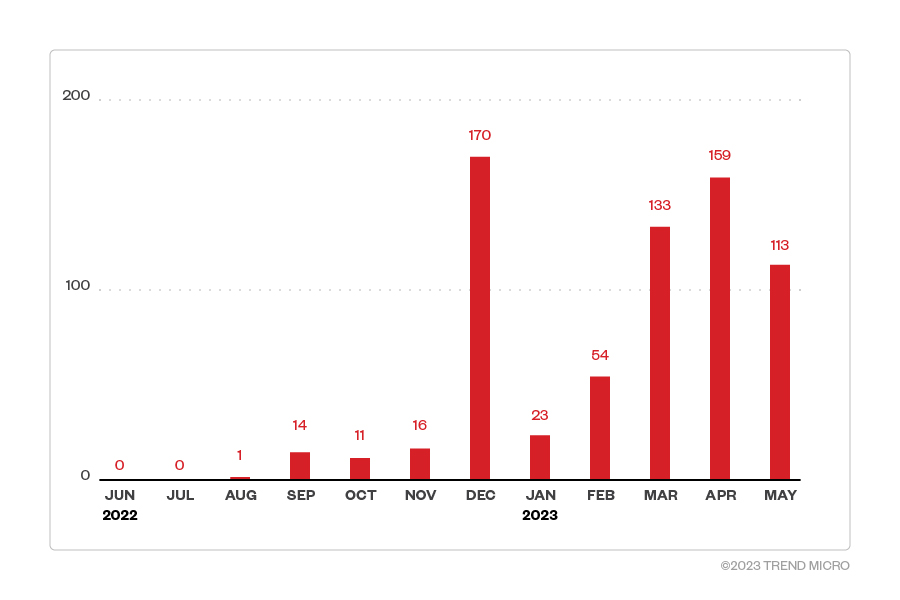
Au début de sa progression, Trend Micro a détecté le ransomware Play sur jusqu’à 170 machines en un seul mois. Depuis lors, le groupe a revendiqué plus de 1 300 victimes sur son site de diffusion.
Examinons comment Play s’intègre, comment il se déplace dans un réseau et que vous pouvez faire pour le stopper.
Qu’est-ce que Play ransomware ?
Depuis juin 2022, Play (également connu sous le nom de PlayCrypt et détecté par Symantec sous le nom de Balloonfly) a ciblé un large éventail d'entreprises et d'infrastructures critiques en Amérique du Nord, en Amérique du Sud et en Europe.
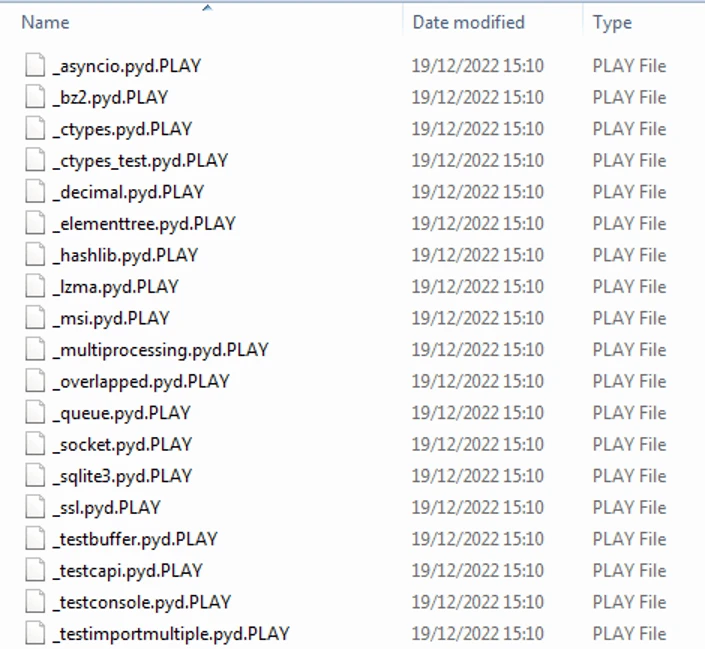
Le groupe tire son nom de .jouer Cette extension ajoute des informations aux fichiers cryptés.
Play utilise un modèle de double extorsion : elle extrait d’abord les données d’une organisation, puis chiffre ses systèmes, et menace de publier les données volées si l’argent de rançon n’est pas versé.
Les sources divergent quant à l’organisation du groupe. Le FBI et la CISA décrivent Play comme un groupe présumé fermé qui, selon son site de fuite, vise à “ garantir le secret des transactions ”. D’autres chercheurs, dont Kroll, Le groupe Palo Alto Networks a décrit cette activité sous le nom de ransomware-as-a-service (RaaS). En octobre 2024, l’unité 42 de Palo Alto Networks a également signalé que Des acteurs liés à l'État nord-coréen semblent collaborer avec Play, Ils ont fourni un accès initial qui a ensuite été utilisé pour déployer le ransomware.
Quel est l’activité du ransomware Play en 2026 ?
Le jeu reste actif, bien que sur un rythme plus lent que lors de ses années d’apogée. Selon Check Point Research, Play a enregistré 121 victimes au premier trimestre 2026, soit une augmentation de 64% par rapport au trimestre précédent, ce qui la place parmi les dix groupes les plus actifs. Au cours de ce trimestre, 85,1% de ses attaques ont visé des organisations américaines.
L'activité a ralenti au cours de la deuxième moitié de l'année. HackerFeeds On a enregistré 13 cas de victimes de jeu en septembre 2026 et 12 au cours des 19 premiers jours d’octobre, soit environ 12 cas par mois contre environ 40 par mois au premier trimestre.
Les chiffres cumulés varient selon le tracker et la méthodologie. À la mi-octobre 2026, les trackers des sites de fuites comptent environ 1 300 victimes revendiquées depuis 2022, tandis que le FBI connaissait l’existence d’environ 900 entités concernées en mai 2025.
Qui cible Play ransomware ?
Le jeu est opportuniste. Il est souvent décrit comme ciblant les grandes entreprises, mais une grande partie de sa liste d'hôtes est composée d'organisations petites et moyennes, de fournisseurs de services gérés (MSP) et d'entités gouvernementales, selon Kroll.
Géographiquement, Play se concentre fortement sur les États-Unis, suivi de l’Europe, avec des victimes également présentes au Canada, au Royaume-Uni et en Australie. Les pays post-soviétiques ne figurent pas sur la liste des victimes, bien qu’il n’y ait aucune preuve directe de cette intention.
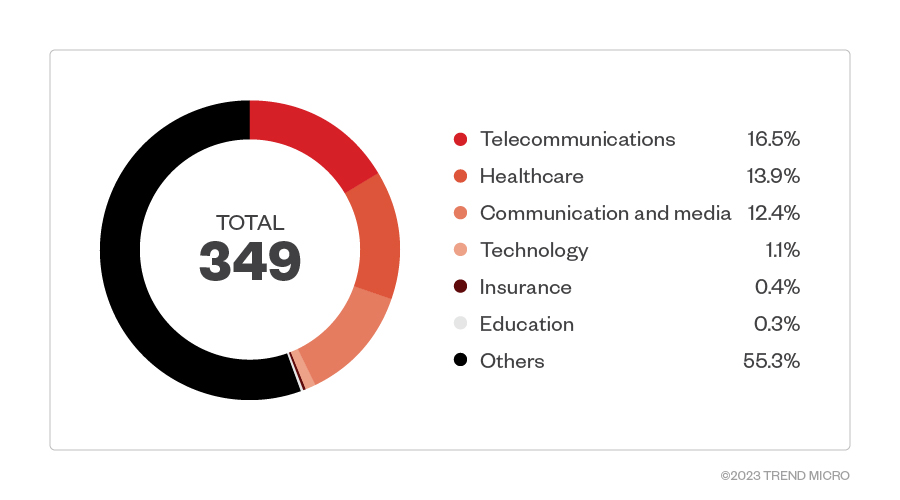
Au cours de ses premières années, les détections de Trend Micro étaient concentrées dans des secteurs tels que les télécommunications et les soins de santé (figure 3). Les données plus récentes concernant les sites de fuites montrent que les secteurs les plus touchés sont l’industrie manufacturière, les services professionnels et la technologie. Les organisations exposées à une pression opérationnelle et ayant de grandes quantités de données sensibles restent des cibles attrayantes, car les temps d’arrêt et la divulgation des données augmentent à la fois la pression pour payer et la nécessité de prendre des mesures correctives.
Comment fonctionne Play ransomware ?
Les activités de Play évoluent régulièrement, ce qui rend le groupe difficile à perturber. Mise à jour en juin 2025 du communiqué conjoint du FBI, du CISA et du ASD Des tactiques et des indicateurs nouveaux ont été ajoutés, et il a été noté que le FBI connaissait environ 900 entités concernées en mai 2025.
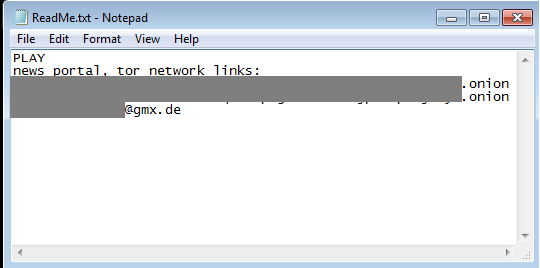
La note de rançon de Play ne mentionne ni le montant de la rançon ni les instructions de paiement. Elle indique plutôt aux victimes de contacter les attaquants par e-mail. Les rançons sont payées en crypto-monnaie vers des portefeuilles fournis par le groupe.
Éléments d'un ransomware Play
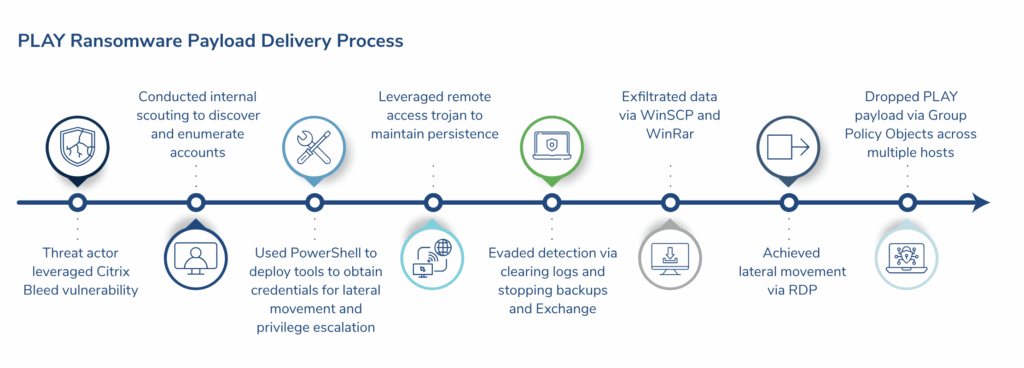
1. Accès initial. Les attaques se produisent généralement par l’utilisation abusive de comptes valides, probablement achetés sur le dark web, ou en exploitant des systèmes connectés à Internet. L’FBI et la CISA ont documenté l’exploitation de vulnérabilités connues dans le système Fortinet FortiOS (CVE-2018-13379 et CVE-2020-12812) et les vulnérabilités Microsoft Exchange ProxyNotShell (CVE-2022-41040 et CVE-2022-41082), as well as abuse of exposed RDP and VPN services.
More recent entry points include:
- Citrix Bleed: Kroll observed Play exploiting CVE-2023-4966 in Citrix NetScaler to breach a professional services firm.
- SimpleHelp RMM: Initial access brokers with ties to Play exploited CVE-2024-57727 in the SimpleHelp remote monitoring and management tool against many US organizations after its January 2025 disclosure.
- Windows zero-day: In 2025, Symantec found Play-linked operators exploiting CVE-2025-29824, a Windows Common Log File System privilege escalation flaw, before Microsoft patched it. The attackers likely entered through a public-facing Cisco ASA appliance.
2. Discovery and defense evasion. Once inside, Play uses AdFind, a third-party command-line tool for querying Active Directory, alongside Grixba, its custom information stealer, to map the network and scan for antivirus and security tools. It then uses tools such as GMER, IOBit, and PowerTool to disable antivirus software and delete logs, and PowerShell scripts to target Microsoft Defender.
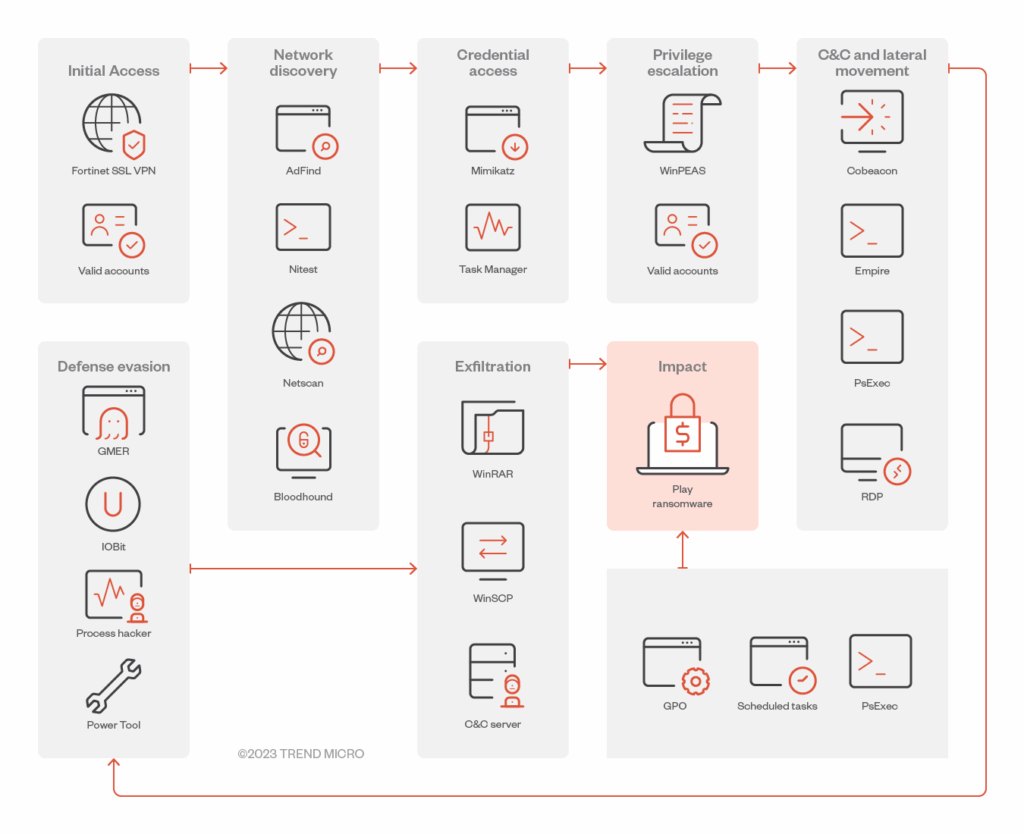
3. Credential access and lateral movement. Play searches for unsecured credentials and uses Mimikatz to dump credentials and gain domain administrator access. It uses WinPEAS to find additional privilege escalation paths. To move laterally and run commands on other machines, it relies on command-and-control frameworks such as Cobalt Strike and SystemBC, remote execution tools such as PsExec, RDP, and remote access software such as AnyDesk. Plink is used to maintain persistent SSH tunnels.
4. Exfiltration. Play splits stolen data into segments, compresses it into .RAR archives with WinRAR, and transfers it to attacker-controlled accounts with WinSCP.
5. Encryption and extortion. The ransomware is distributed across the network through Group Policy Objects (GPOs). Files are encrypted using a hybrid AES-RSA scheme with intermittent encryption, which encrypts only portions of each file. This speeds up encryption and can help evade detection tools that rely on static analysis. System files are skipped so machines stay operational. Play recompiles its ransomware binary for each attack, so every sample has a unique hash.
A ransom note titled ReadMe.txt directs victims to an email address ending in @gmx[.]de ou @web[.]de. If a victim refuses to pay, Play threatens to publish the stolen data on its Tor leak site. Some victims have also received threatening phone calls.
Jouer aux ransomware TTP
The table below maps Play’s observed behavior to MITRE ATT&CK, based on the FBI/CISA/ASD advisory and Kroll’s incident analysis.
| Tactique | Technique | How Play uses it |
|---|---|---|
| Accès initial | T1078 Valid Accounts | Abuses stolen or purchased credentials |
| Accès initial | T1190 Exploit Public-Facing Application | Exploits FortiOS, Exchange, Citrix, and SimpleHelp vulnerabilities |
| Accès initial | T1133 External Remote Services | Uses exposed RDP and VPN services |
| Exécution | T1059.001 PowerShell | Deploys tools and targets Microsoft Defender |
| L'escalade des privilèges | T1068 Exploitation for Privilege Escalation | Exploited CVE-2025-29824 as a zero-day |
| Évasion de défense | T1562.001 Disable or Modify Tools | Uses GMER, IOBit, and PowerTool to disable antivirus |
| Évasion de défense | T1070.001 Clear Windows Event Logs | Deletes logs to hide activity |
| Credential Access | T1552 Unsecured Credentials | Searches for credentials stored insecurely |
| Credential Access | T1003 OS Credential Dumping | Uses Mimikatz to obtain domain admin access |
| Découverte | T1016 System Network Configuration Discovery | Uses Grixba to map network settings |
| Découverte | T1518.001 Security Software Discovery | Scans for antivirus and security tools |
| Découverte | T1087.002 Domain Account Discovery | Enumerates domain accounts with AdFind |
| Mouvement latéral | T1021.001 Remote Desktop Protocol | Moves between hosts over RDP |
| Mouvement latéral | T1570 Lateral Tool Transfer | Distributes executables inside the network |
| Defense Evasion / Privilege Escalation | T1484.001 Group Policy Modification | Pushes the ransomware via GPOs |
| Command and Control | T1219 Remote Access Software | Maintains access with remote access tools |
| Collection | T1560.001 Archive via Utility | Compresses stolen data with WinRAR |
| Exfiltration | T1048 Exfiltration Over Alternative Protocol | Transfers data with WinSCP |
| Impact | T1489 Service Stop | Stops backup and Exchange services |
| Impact | T1486 Data Encrypted for Impact | Encrypts files with intermittent AES-RSA encryption |
| Impact | T1657 Financial Theft | Extorts victims through double extortion |
Version Linux d'ESXi
In July 2024, Trend Micro researchers discovered a Linux variant of Play ransomware built to target VMware ESXi. The variant runs ESXi-specific shell commands to power off all running virtual machines (VMs), list machine names, and replace the ESXi welcome message with the ransom note. Because a single ESXi host can run many business-critical VMs, this variant lets Play cause widespread disruption with one payload.

Indicateurs de compromission (IoCs) du ransomware Common Play
Play works hard to stay hidden, but its intrusions leave recognizable traces.
Watch for these observed Play ransomware IoCs:
- Custom reconnaissance tool: Grixba (seen as
GT_NET.exe) enumerates users, computers, and installed security and remote-access software, then saves the results to CSV files compressed into a ZIP archive. - Staging folders: Tools and exploits are often dropped in public user directories such as
C:\Users\Public\Music, sometimes with names that impersonate legitimate security software. - Remote execution and tunneling: Unexpected use of PsExec, Plink, AnyDesk, Cobalt Strike, or SystemBC, especially from servers or accounts that don’t normally use them.
- Security tool tampering: GMER, IOBit, or PowerTool on endpoints, PowerShell commands that disable Microsoft Defender, and cleared Windows event logs.
- Data staging and exfiltration: Large, segmented WinRAR archives followed by WinSCP transfers to external hosts.
- Suspicious GPO changes: New or modified Group Policy Objects that push executables across many hosts.
- Encryption and ransom note: Files renamed with the
.jouerextension and aReadMe.txtransom note pointing to a@gmx[.]deou@web[.]deaddress.
Because Play recompiles its binary for each attack, file hashes go stale quickly. Prioritize behavioral detection and use the current IOC files published by CISA for threat hunting.
Protégez-vous contre Play ransomware
Play relies on known vulnerabilities, exposed remote access, and legitimate tools. The FBI, CISA, and ASD recommend mitigations aligned with CISA and NIST’s Cross-Sector Cybersecurity Performance Goals. Here are the priorities:
- Patch known exploited vulnerabilities first. Prioritize internet-facing systems such as VPNs, firewalls, Citrix and Exchange servers, and RMM tools like SimpleHelp. Play has repeatedly exploited flaws that were patched years earlier.
- Enable multifactor authentication (MFA). CISA stresses MFA for all services where possible, particularly webmail, VPN, and accounts that access critical systems. Phishing-resistant MFA, such as FIDO security keys, offers the strongest protection.
- Use long, unique passwords. Follow NIST password guidance: favor long passwords, avoid reuse, and lock accounts after repeated failed logins. CISA advises against requiring password changes more than once a year, because frequent resets lead to predictable patterns.
- Lock down remote access. Restrict RDP and VPN access to authorized IP ranges, use conditional access and geo-fencing, and disable unused ports. Audit remote access and RMM tools, and remove any that aren’t approved.
- Tighten access controls. Apply the principle of least privilege, use just-in-time access for admin accounts, and regularly review domain controllers and Active Directory for new or unrecognized accounts.
- Segmentez votre réseau. Segmentation limits how far ransomware can spread once an attacker is inside.
- Monitor network and endpoint activity. Use EDR and network monitoring to spot lateral movement, unusual GPO changes, large outbound transfers, and communication with known command-and-control servers.
- Maintain offline, immutable backups. Keep encrypted, immutable backups that cover all critical data, store them offline, and test restoration regularly. Protect ESXi hosts and their backups in particular.
- Implement a recovery plan. Follow NIST guidelines to define how you will detect, respond to, and recover from a ransomware incident.
FAQ
Oui. Play continue d'enregistrer de nouvelles victimes chaque mois en 2026, bien que ce soit à un rythme plus lent que dans le premier trimestre de l'année, lorsque le nombre de victimes était de 121 selon Check Point Research.
Not on its own. CISA reports that Play uses GMER, PowerTool, and IOBit to disable antivirus software, and its recompiled binaries defeat hash-based detection. Combine antivirus with EDR, patching, and MFA.
Le phishing n’est pas le principal moyen d’attaque de Play. Le groupe s’appuie principalement sur des identifiants volés, des services RDP et VPN exposés et des systèmes vulnérables accessibles par Internet.
Le phishing n’est pas le principal moyen d’entrée d’attaque de Play. Le groupe s’appuie principalement sur des identifiants volés, des services RDP et VPN exposés et des systèmes vulnérables accessibles sur Internet. Après une attaque, certaines victimes reçoivent des appels téléphoniques menaçants les obligeant à payer.
PowerShell est un outil de scriptage intégré à Windows. Play l’utilise pour déployer des outils tels que Mimikatz, exécuter des commandes et désactiver ou contourner Microsoft Defender, ce qui permet aux pirates d’imiter les activités administratives légitimes.
Play compile son fichier binaire de ransomware à chaque attaque, de sorte que chaque échantillon possède un hachage unique. Cela rend la détection antivirus basée sur l’hachage inefficace et explique pourquoi la détection comportementale est importante.
If a victim refuses to pay, Play publishes the stolen data on its Tor leak site. In 2023, Play attacked Xplain, a Swiss IT provider for government agencies. After Xplain refused to pay, the group leaked the stolen data, which included about 65,000 Swiss federal government documents.
Conclusion
Play has stayed active for four years by adapting: new entry points, new tools, and an ESXi variant. What hasn’t changed is its reliance on exposed edge devices, unpatched vulnerabilities, and compromised credentials. That’s also where defenders can stop it.
Like other major ransomware actors, Play is far easier to stop before it gets in than after. Detecting exposure early keeps an incident from escalating, protecting your daily operations and your customers’ data.
With CybelAngel, you can map and monitor your exposed assets with gestion de la surface d'attaque, and identify exposed credentials before attackers use them with Credential Intelligence.
À propos de l'auteur