AI Agent Security: How CISOs Are Governing AI Agents
目次
AI agent security has become a board-level question faster than most security programmes were able to prepare for it, and the people who are accountable for it say so openly. In a 2026 survey of more than 300 CISOs and security executives, fewer than half were confident that they could identify every AI agent in their environment, and 81% were concerned that those agents already have more access than they should.
This guide explains what AI agent security and AI agent governance mean in practice, which risks matter most, and how security leaders are actually handling the problem today. It draws on the third edition of The Essential CISO Primer, in which we put the same five questions to nine cybersecurity leaders and printed their answers side by side, including the question of what is on their agent inventory and who approves an agent before it reaches production.
What is AI agent security?
AI agent security is the practice of controlling what autonomous AI systems can reach, what they are permitted to do and how their actions are recorded, so that an agent cannot be turned against the organisation that runs it. An AI agent differs from a chatbot in that it does not stop at producing text, because it holds credentials, calls tools, reads and writes data and chains several actions together with little or no human review in between.
That difference is why agentic AI security cannot be handled as an extension of data loss prevention or acceptable use policy alone. The question a security team has to answer is no longer only what an employee typed into a model, but what a piece of software with its own permissions decided to do next, on whose behalf, and whether anybody would be able to reconstruct that decision afterwards.
Why AI agent security is now a CISO problem
The clearest signal came in November 2025, when Anthropic disclosed that a group it assessed to be Chinese state-sponsored had manipulated its Claude Code tool into attempting to infiltrate roughly thirty organisations, succeeding in a small number of cases, with the AI carrying out the large majority of the tactical work itself. We covered the lessons of that campaign in our analysis of the first autonomous AI breach, and the point that matters here is that the attackers kept the model cooperative by breaking the job into small tasks that each looked innocent.
The second signal is internal, and it has less to do with attackers than with ordinary adoption. Okta and Apprize360 found that 90% of executives are confident in their visibility of AI tools while 52% of employees in the same survey admit to using AI tools without approval, and 58% of those executives said their organisation had experienced an AI-related security incident or close call in the previous twelve months.
The incidents themselves are often mundane. The OWASP GenAI exploit round-up for the first quarter of 2026 records an internal agent at Meta whose flawed engineering advice exposed sensitive data inside the company for about two hours, and a case in which researchers showed that an agent deployed on Google’s Vertex AI inherited excessive default permissions from a managed service account. Neither involved a novel exploit, and both came down to an agent holding more access than anyone had deliberately given it.
The main AI agent security risks
について OWASP Top 10 for Agentic Applications, published in December 2025, is the most widely used reference for agentic AI security risks, and the entries that security leaders raise most often are the following.
- Agent goal hijack. Instructions hidden in an email, a web page, a document or a code repository redirect the agent towards an attacker’s objective, which is the agentic form of prompt injection.
- Tool misuse. An agent uses a legitimate tool, such as a file system, a terminal or an API, in a way that its owner never intended, for example by deleting data it was only meant to read.
- Identity and privilege abuse. Agents that borrow a human user’s credentials or run under a broad service account can do everything that identity can do, and their actions are attributed to the wrong person.
- Shadow agents. Employees install coding assistants, browser agents, plugins and locally hosted models without telling anyone, which means that the inventory is incomplete on the day it is written.
- Supply chain compromise. Agents depend on models, connectors and packages maintained by other people, and a poisoned dependency reaches every agent that uses it, as the LiteLLM supply chain attack showed.
- Missing forensics. Logs record which calls an agent made, but they rarely record what the agent was trying to achieve or which instruction it was following, so that an investigation stalls at the point where intent matters.
What is AI agent governance?
AI agent governance is the set of decisions about who may deploy an agent, what it may access, who answers for its actions and how those rules are checked over time. Where AI agent security is concerned with controls, agentic AI governance is concerned with ownership, and frameworks such as the NIST AI Risk Management Framework describe the principles without settling the practical question of whose name goes next to each agent.
That question is the first pillar of this year’s primer, and the answers we received were candid about how unsettled it remains.
So how exactly are CISOs governing AI agents?
They start with an agent inventory, and admit that it is incomplete
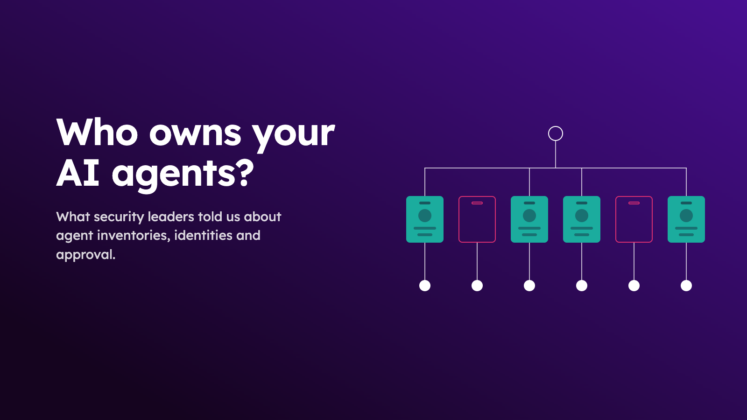
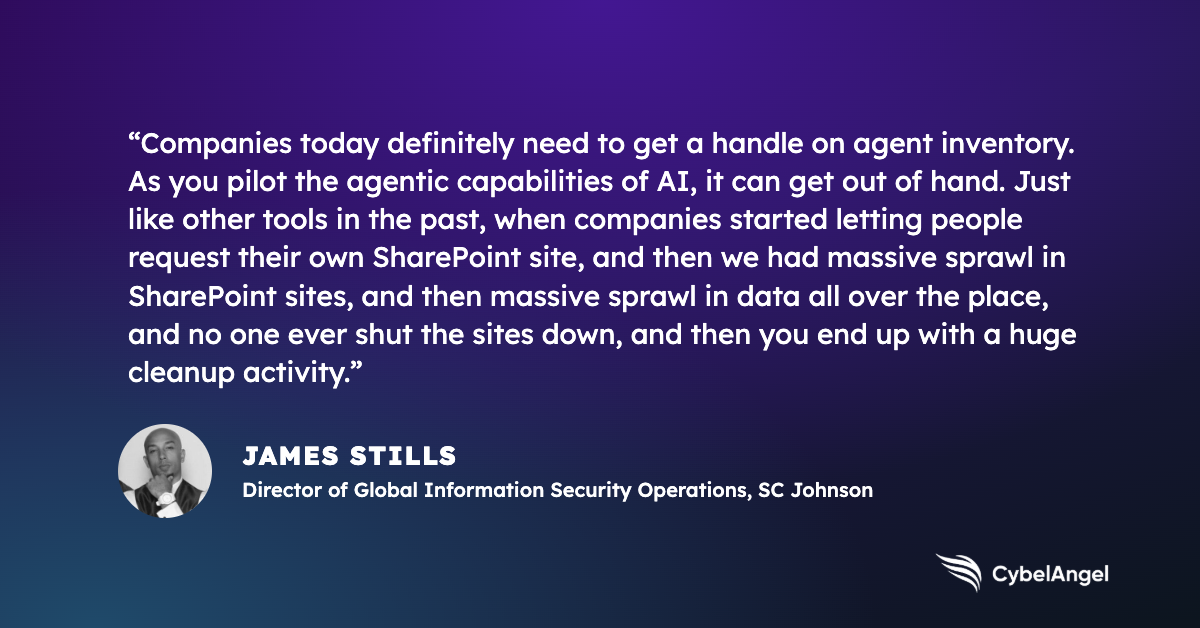
Every leader we spoke to treated the AI agent inventory as the starting point, and none of them claimed that theirs was finished. Gerhard Burtscher, Head of Information Security at SEFAR, told us that his organisation does not officially use any AI agents and that he assumes some unofficial use is probably already happening, which is a more useful position than confidence that cannot be tested.
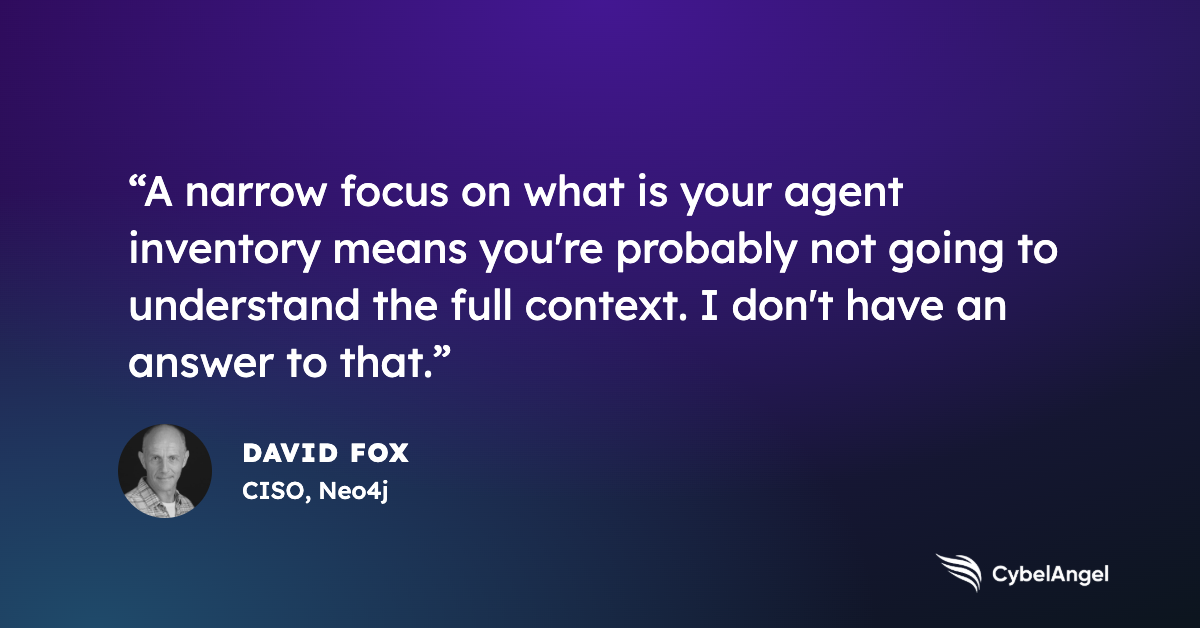
David Fox, CISO of Neo4j, argued that the inventory has to be drawn more widely than agents alone, because the same exposure arises wherever people build harnesses, connect MCP tooling or run a large language model on their own laptop.
They record what each agent is allowed to do
They give agents their own identity
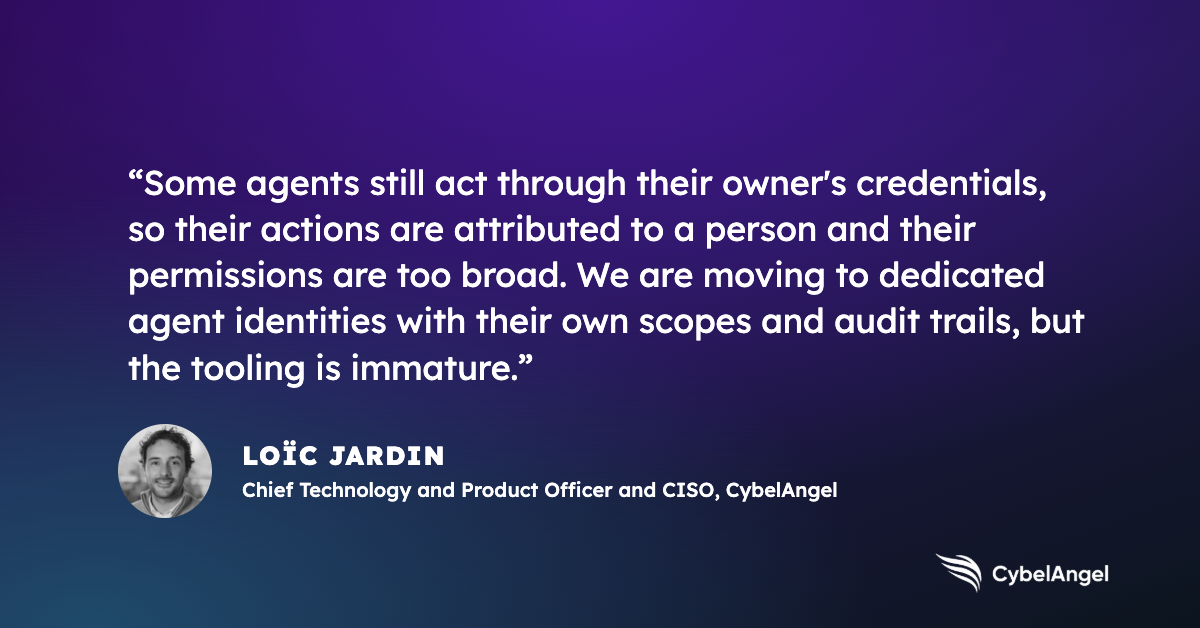
AI agent identity is where governance meets the older problem of non-human identities, the service accounts, API keys and tokens that the OWASP Non-Human Identities Top 10 was written to address. Loïc Jardin, Chief Technology and Product Officer and CISO at CybelAngel, was direct about the gap in our own environment.
They measure before they automate further
Approval is not a single decision made at deployment, and the leaders who were furthest along described extending an agent’s autonomy in steps, with evidence at each one. Loïc Jardin explained that in CybelAngel’s pilot repositories about 80% of recently merged merge requests, 85 of 107, needed no reviewer action at all, and that the team is now measuring the agent’s accuracy against human reviewers before allowing it to merge anything on its own, with automatic merging remaining opt-in and never the default.
They plan for the investigation they cannot yet run
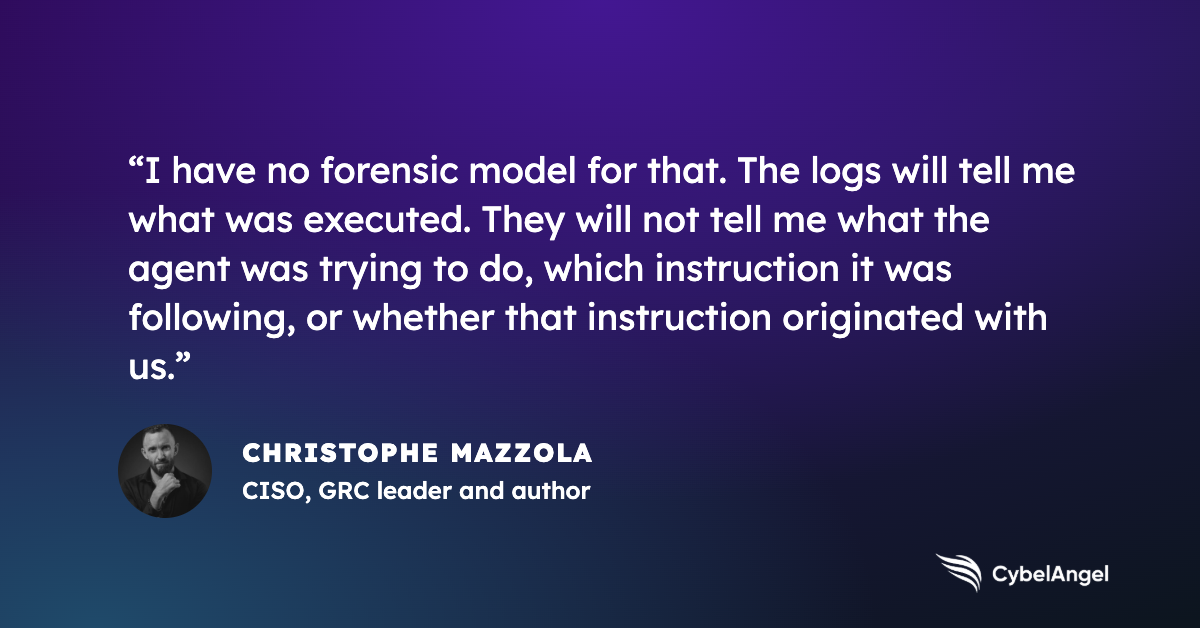
Asked what he is not ready for, Christophe Mazzola described an agent that authenticates as a service account, chains five actions across four systems and triggers nothing anomalous because every individual call was authorised.
Read this dialogue and a whole lot more
The Essential CISO Primer puts the same five questions to nine security leaders, covering ownership of AI agents, what to expect from suppliers, how to explain risk to a board, and what they have stopped doing this year. They did not always agree, and we left the disagreements where they fell.
AI agent governance checklist
The following steps reflect what the primer’s contributors are doing now, and they can be started without buying new tooling.
- Build the inventory, then widen it. List sanctioned agents first, and then look for coding assistants, browser extensions, MCP servers and locally hosted models that nobody registered.
- Name an owner for every agent. Each agent should have a person who approved it and who answers for what it does, in the same way that an application has a business owner.
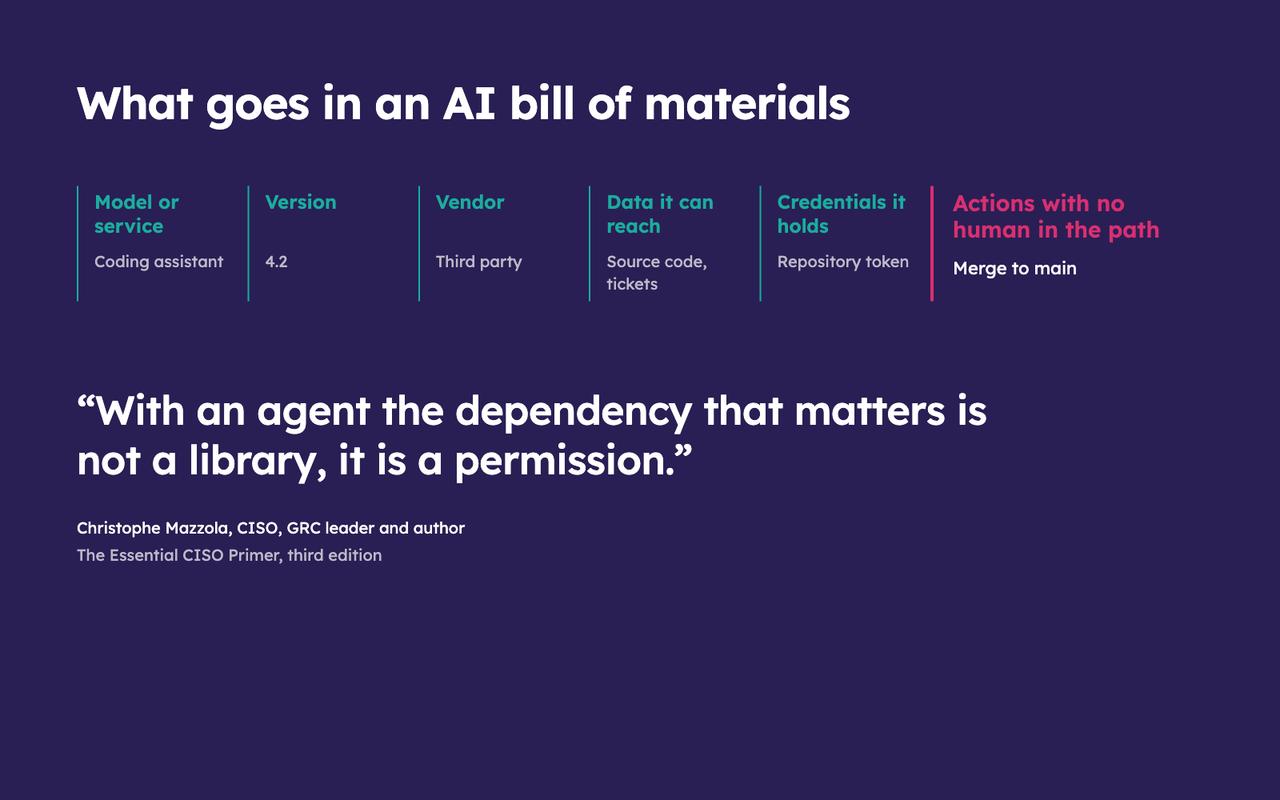
- Record permissions, not only components. For each agent, write down the data it can reach, the credentials it holds and the actions it can take without a human in the path.
- Issue dedicated agent identities. Stop agents from acting through a person’s credentials, scope each identity to the task and rotate its secrets on a schedule.
- Extend autonomy in steps. Measure an agent’s accuracy against human reviewers before removing the reviewer, and keep fully automatic actions opt-in.
- Check what AI-built software ships. Applications produced with AI assistants should pass the same automated security checks as any other code before release.
- Log intent as well as actions. Where the tooling allows it, keep the prompts and instructions an agent received alongside the calls it made.
- Report it in terms a board can use. Count agents with an owner, agents with a dedicated identity and agents with write access, and present them next to the other indicators on your CISO dashboard.
How CybelAngel helps secure AI agents
Much of the exposure that AI agents create becomes visible outside the network before it is noticed inside it, which is where external monitoring adds to the controls described above.
- Find what nobody registered. サイベルエンジェル アタックサーフェスマネジメント solution continuously scans the internet, including shadow IT and third-party assets, to identify exposed services and misconfigured systems that were never added to an inventory.
- Detect leaked agent credentials. API keys, tokens and service account secrets are the identities that agents run on. CybelAngel’s 資格情報インテリジェンス alerts you when credentials tied to your organisation are exposed online, so that they can be revoked before they are used.
- Catch data that has already left. サイベルエンジェル データ漏洩防止 detects sensitive documents and data exposed outside your perimeter, including by suppliers and the tools they run.
よくある質問
AI agent security is the practice of controlling what autonomous AI systems can access, what actions they can take and how those actions are logged. It covers the agent’s identity and permissions, the tools and data it can reach, protection against prompt injection, and the ability to investigate what an agent did and why.
AI agent governance is the set of rules that decide who may deploy an AI agent, who owns it, what it is allowed to access and how those permissions are reviewed over time. In practice it starts with an inventory of agents and a named owner for each one.
There is no settled answer yet. In most organisations the CISO is accountable for the security of AI agents, while the business team that deploys an agent owns its purpose and outcomes. Security leaders interviewed for The Essential CISO Primer recommend naming an individual owner for every agent before it reaches production.
An AI agent inventory is a maintained list of every AI agent operating in an organisation, including who owns it, which model it uses, what data and systems it can reach and which credentials it holds. Security leaders advise extending it to coding assistants, MCP servers and locally hosted models.
An AI bill of materials, or AI BoM, lists every model and AI service in use together with its version, vendor, data access, credentials and the actions it can take without human approval. Unlike a software bill of materials, it has to describe what a system is allowed to do and not only what it is made of.
The OWASP Top 10 for Agentic Applications lists agent goal hijack, tool misuse and identity and privilege abuse among the leading risks. Security leaders also point to unsanctioned agents, compromised dependencies and the difficulty of reconstructing an agent’s intent after an incident.
Non-human identities are the service accounts, API keys and tokens that software uses to authenticate. An AI agent uses those identities but also decides for itself which actions to take, which is why agents need dedicated identities with narrow scopes and their own audit trails.
著者について