Brand Monitoring Services: How to Compare Them
目次
Search for brand monitoring services and you will get two different product categories on the same results page, described in almost identical language.
One defends your trademark against counterfeits and grey market sellers. The other defends your customers and executives against people impersonating you. Different vendors, different buyers, different price points, and buying the wrong one is the most expensive mistake in this category.
This guide walks through these points, and shares a scorecard for comparing vendors on the security side for you at the end.
First, which category are you buying?
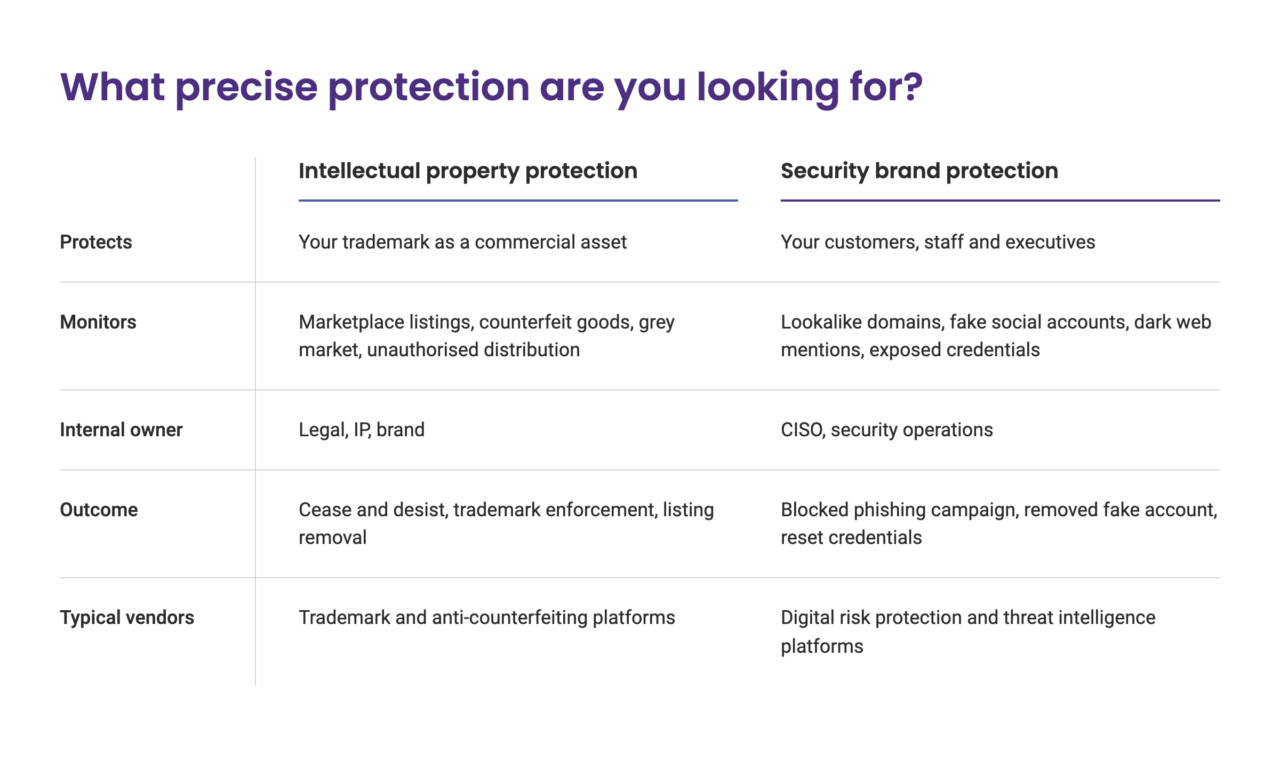
Why this matters before anything else: A counterfeit monitoring platform will not tell you someone registered a lookalike domain and is invoicing your customers from it. A security platform will not help you enforce a trademark against an unauthorised reseller. Neither is deficient. They are different products.
Some organisations buy both, because they are two genuinely separate problems with two separate budgets.
If your owner is legal or brand, stop here and shortlist IP-side vendors. Everything below covers the security side.
The four capabilities, and how to score them
Every security-side vendor will claim all four. The difference is depth. Use the rubric below to score each vendor from 1 to 3 on each capability, and ask the question in bold on every call.
1. Domain impersonation
Attackers register variants of your domain for phishing, invoice fraud and credential harvesting.
| Score | What it looks like |
|---|---|
| Thin | Periodic sweep of registered domains. Simple character swaps only. Tells you a domain exists. |
| Adequate | Monitors new registrations and certificate transparency logs. Covers homoglyphs and alternative top-level domains. |
| Strong | All of the above, plus weaponisation signals: whether the domain has mail records configured, is hosting a cloned login page, or has resolved to live infrastructure. Takedown included. |
Ask: how soon after registration do you detect a lookalike domain, and do you tell me whether it is weaponised or dormant?
2. Social media impersonation
Fake accounts using your name, branding or executives’ identities.
| Score | What it looks like |
|---|---|
| Thin | Exact brand name matches on the two or three largest platforms. |
| Adequate | Multiple platforms, including accounts using your logo without your exact name. |
| Strong | Broad platform coverage extending to messaging apps, detection of executive impersonation where no company branding appears at all, and takedown included in the licence rather than metered. |
Ask: how do you detect accounts that do not use our exact brand name, and is takedown included or charged per removal?
3. Dark web and underground monitoring
Mentions of your organisation on forums, marketplaces, extortion leak sites and closed channels.
| Score | What it looks like |
|---|---|
| Thin | Keyword matching across publicly indexable sources. Alerts on any mention. |
| Adequate | Some closed sources. Basic filtering of irrelevant mentions. |
| Strong | Meaningful coverage of invite-only and access-controlled sources, analyst validation before delivery, and the ability to distinguish a passing brand mention from an actual exposure of your data. |
Ask: what proportion of your sources require access that cannot be scraped, and who reviews a finding before it reaches me?
4. Credential and account takeover exposure
Credentials tied to your domains appearing in infostealer logs, combolists and breach dumps.
| Score | What it looks like |
|---|---|
| Thin | Matches against public breach databases. Historical data, largely recycled. |
| Adequate | Fresh sources, correlated to your domains. |
| Strong | Fresh sources correlated to your domains and your suppliers’ domains, with verification of whether a credential is still live rather than recycled from an old dump. |
Our advice is to ask how soon after a credential appears will you hear about it, and will your vendor verify whether it still works?
Reviewing your vendor scorecard to get it right
Take a look at the scorecard below to access what coverage and capabilities are available to you.
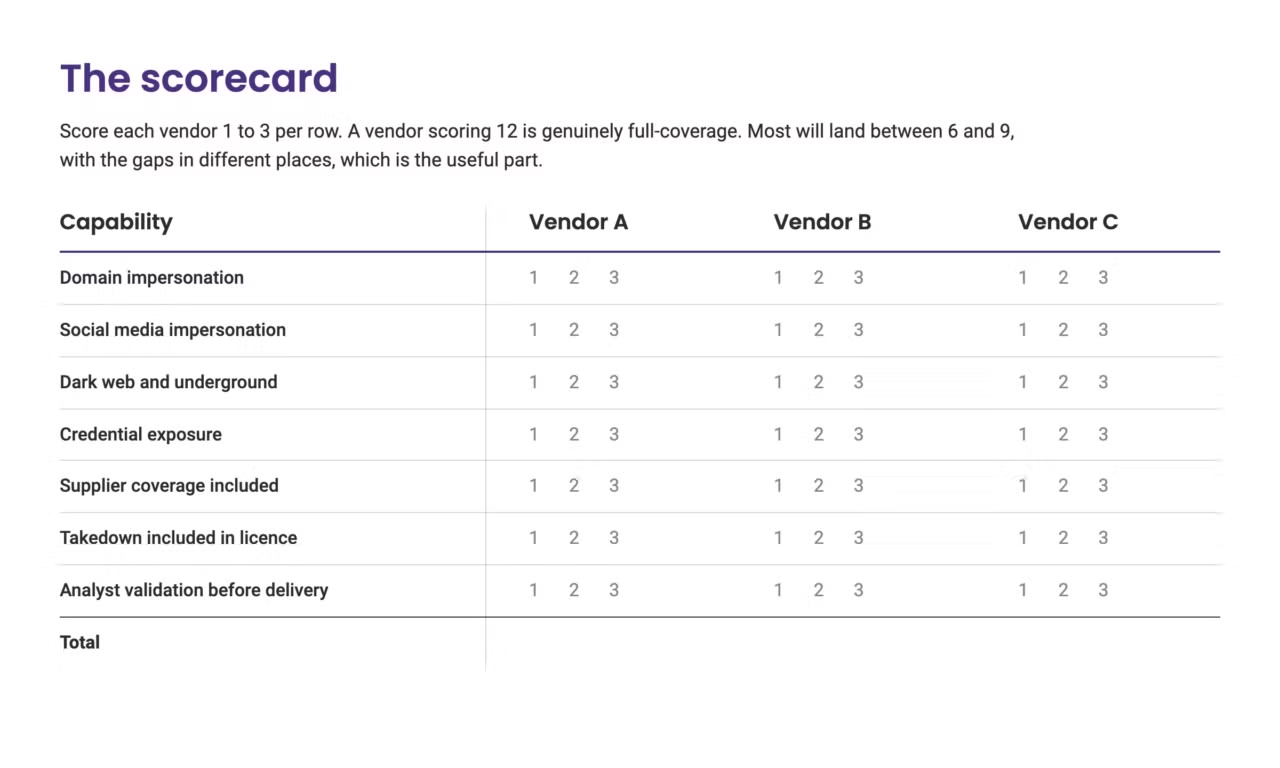
The last three rows decide more deployments than the first four. A vendor with strong detection and no takedown, no supplier coverage and no validation will generate work rather than remove it.
Detection or evidence? The question most demos avoid
Every platform shows a full dashboard in the demo. The difference appears in month three.
A detection says something exists. A lookalike domain was registered. An account using your logo appeared. Your brand was mentioned on a forum.
Evidence says what it means. The domain has mail records configured and hosts a cloned login page. The account is actively messaging your customers. The forum post contains an extract of your customer data rather than a passing reference.
Why this decides the purchase: the first model moves the analytical work to your team. For a security team of four, a platform generating two hundred unvalidated findings a month is a cost, not a control. The platform that looks cheapest at signature is frequently the one producing the most noise.
Ask for a stated false positive rate on qualified incidents. Vendors who validate will give you a number. Vendors who do not will change the subject.
What actually drives the price
Licence cost in this category usually scales with three variables, and it is worth knowing which ones a vendor uses before you negotiate.
- Scope counted in brands, domains or keywords. Keyword-based pricing punishes organisations with multiple brands or product names. Ask what happens when you add a brand mid-contract.
- Whether takedown is included, metered or excluded. This is the single largest hidden variable. A cheaper licence with per-takedown fees can cost more in year one than a higher licence with unlimited removals.
- Whether supplier coverage is included. Vendor-originated exposure is the fastest-growing category and the one most commonly sold as an add-on.
The number to compare is not licence cost. It is cost per qualified incident, which you can only calculate after a trial that counts the noise.
How to run a 30-day evaluation
One success criterion: did the platform surface something you did not already know?
Seed it with known cases. Give every vendor three things you have already handled: a lookalike domain, a fake account, a credential exposure. A platform that misses what you found will miss what you have not.
Count detections that required no action. Not the total findings, the wasted ones. That ratio is the operational cost and it is the number vendors least want measured.
Make them action one real takedown. Success rate and time to removal vary far more between vendors than detection coverage does, and neither is usually discussed until after signature.
Check supplier scope explicitly. Ask whether the platform monitors impersonation and exposure at your suppliers or only at your own organisation, and whether that is included or priced separately.
Where CybelAngel fits
We sit on the security side, and the four capabilities are part of the platform rather than four separate purchases.
ドメイン保護 detects lookalike and typosquatted domains including weaponisation signals. Social Media Monitoring identifies impersonation accounts and executive impersonation across platforms. ダークウェブモニタリング tracks mentions across underground forums, marketplaces and extortion leak sites. Account Takeover Prevention surfaces exposed credentials tied to your domains. Vendor Exposure extends the same detection to your suppliers.
Every detection is reviewed by an analyst before it reaches you and arrives as a qualified incident with context and remediation guidance.
What we do not do: counterfeit product monitoring, marketplace listing enforcement, grey market tracking or trademark litigation. If your problem is fake products on marketplaces, buy an IP-side platform. Expecting a security platform to cover it will disappoint you, and any vendor claiming both deserves a harder look.
Top brand monitoring guides to read next
We have a few succint guides to help you evaluate tools, costs, and find more information for your needs!
- Brand protection tools: how to evaluate them is the full vendor-agnostic checklist, and the natural next step once you have a shortlist.
- Domain impersonation and what it costs traces how a lookalike domain becomes invoice fraud, with the financial exposure quantified.
- 6 things to know about domain squatting covers the legal position and the fastest routes to getting a domain removed.
- Social media impersonation and brand protection goes deeper on platform coverage and the takedown process.
- Task scams and brand impersonation is a worked example of a live fraud scheme running on impersonated brands.
- How CISOs manage brand protection on social media covers internal ownership and where this usually breaks down operationally.
- Brand counterfeiting: how it works and how to stop it covers the intellectual property side, if the table at the top put you in that column.
Brand monitoring services FAQs
Not always, and this is the widest gap between what buyers assume and what they receive. Some vendors detect and hand you evidence. Some file on your behalf. Some charge per takedown or cap the volume included. Get it in writing, along with historical success rate and average time to removal.
Pricing scales with brands, domains or keywords monitored, and with whether takedown and supplier coverage are included. The larger variable is operational: an unvalidated feed consumes analyst time your team may not have. Compare cost per qualified incident, not licence cost.
Registering a similar domain is not automatically illegal. It becomes actionable with bad faith intent, such as reselling at inflated cost, diverting traffic, or impersonating a brand for fraud. In the United States the Anticybersquatting Consumer Protection Act provides a route, and the UDRP process administered through ICANN offers an international mechanism that is usually faster and cheaper than litigation. Domains used for phishing can often be removed faster through the registrar or hosting provider on abuse grounds than through a trademark claim.
The better platforms do, and it is worth asking specifically because coverage varies widely. Executive impersonation is harder to detect than brand impersonation, because a fake account may use a person’s name and photograph with no company branding at all. Ask how a vendor detects accounts carrying neither your logo nor your brand name.
The terms are used interchangeably, which is part of the problem. The distinction that matters is not between the two words but between the two categories in the table above. Establish which category a vendor sits in before comparing any features.
Before you compare vendors
- Confirm which category you are buying, and which team owns the problem.
- Score the four capabilities separately rather than accepting a single coverage claim.
- Weight the last three scorecard rows heavily: supplier coverage, takedown, validation.
- Get takedown scope and pricing in writing before signature.
- Run a 30-day trial that counts the noise, not just the findings.
If you want to see what is already impersonating your organisation before you build a shortlist, reach out.
著者について