Cyber Threat Intelligence Tools: How to Evaluate Them in 2026 (Buyer’s Checklist)
目次
について SANS 2025 CTI Survey, based on responses from 489 threat intelligence professionals, found that only 55% of CTI programs measure their own effectiveness at all. Nearly half of the organizations paying for threat intelligence right now have no formal way of knowing whether it’s working. That’s not a training gap or a maturity problem exclusive to small teams. It’s a category-wide symptom of a market that has spent years selling volume, more feeds, more indicators, more sources, without a shared, consistent answer to the question a buyer actually needs answered: does this make anyone’s decisions better.
This guide skips the sales pitch and the definitional explainer. It’s a checklist for evaluating a cyber threat intelligence platform on the things that actually separate a program that changes decisions from one that generates a bigger backlog: what it costs to get this wrong, seven things worth checking before you sign, who should be in the room, and the questions that expose the difference between curated intelligence and repackaged noise.
What actually counts as cyber threat intelligence
Cyber threat intelligence spans a wider range of delivery formats than most other categories in this series, and vendors routinely sell one piece of it as if it were the whole thing. A complete platform generally includes four distinct layers: indicator of compromise (IOC) feeds for direct integration into detection tooling, curated intelligence (analyst-written threat notes, custom reports, and threat actor profiles), supply chain intelligence (visibility into third-party and vendor exposure), and on-demand investigation services for specific, high-priority questions a standing feed can’t answer.
A tool that only delivers one of these four is a real, useful product, but it is not a complete cyber threat intelligence program, regardless of how it’s marketed. The gap between “we have a threat intelligence feed” and “we have cyber threat intelligence” is almost always the analyst layer that turns raw indicators into something a security team can act on with confidence. If a specific finding type is the priority rather than the full platform, ダークウェブモニタリング, データ漏洩防止, 資格情報インテリジェンス, 、そして ブランド保護 each have their own dedicated evaluation guide in this series.
The real cost of getting this wrong
Bad threat intelligence doesn’t fail loudly. It fails quietly, by adding volume without adding signal, until a program that looks well-resourced on paper produces almost no operational value.
The same SANS 2025 survey found that 34% of CTI professionals cite a lack of skilled staff as a primary roadblock, and separately, that 72% of organizations already use a threat intelligence platform to feed detection and response. The tooling is rarely what’s actually holding a program back. The gap sits between having a feed and having the analytical capacity to interpret it, exactly the gap a vendor’s own analyst layer is supposed to close rather than shift back onto an already-stretched team.
The cost compounds specifically around indicator freshness. Threat infrastructure, malicious IPs, domains, and hashes, gets rotated by attackers precisely because static indicators lose their value fast. A feed that delivers an indicator well after it was first observed is not neutral. It adds review time for something no longer actionable, which is a real cost even when it never shows up as a line item.
Why more feeds isn’t more intelligence
A common instinct when threat intelligence feels ineffective is to add another feed. This usually makes the problem worse, not better. More sources without a way to prioritize, deduplicate, and contextualize them means more raw volume landing on the same analysts, with no corresponding increase in what they can actually process.
The SANS data on measurement gaps points at the same root issue from a different angle: an organization that can’t measure whether its current intelligence program is effective has no reliable way to know whether a second feed would help or just add noise. The fix isn’t volume. It’s context, specifically, whether a new indicator is tied to a campaign, an industry, or a confirmed active threat relevant to your environment, versus being one more unlabeled entry in a growing list.
The 7-point evaluation checklist
1. Source diversity, named specifically Ask exactly which layers of the internet are covered, open web, deep web, dark web, closed channels like Telegram and Discord, and how many distinct sources feed into the platform. As a benchmark, CybelAngel’s own coverage spans 10 million new dark web posts a month, 600,000 new discussions across closed Telegram and WhatsApp channels, and 125,000 new threats tracked across additional platforms. Use figures at that scale as the standard, not a reason to accept a vague answer.
2. Indicator freshness and decay Ask how quickly an indicator moves from first observation to delivery, and what happens to indicators once they age out of relevance. A platform with no answer for indicator decay is a platform quietly delivering stale data alongside fresh data with no way to tell them apart.
3. Context, not just indicators An IP address or a file hash with no accompanying context tells a security team almost nothing actionable. Ask whether findings are tied to a named threat actor, a campaign, or a specific tactic mapped to a recognized framework, and whether that context is written by an analyst or generated automatically with no human review.
4. Curated intelligence, not just automated feeds Ask specifically what proportion of intelligence delivered is analyst-authored (threat notes, actor profiles, contextualized reports) versus purely automated feed output. A platform that’s entirely automated is a data pipeline, not an intelligence program, regardless of what it’s called in the pricing sheet.
5. Supply chain and third-party coverage Ask whether the platform extends visibility to vendors, suppliers, and recent M&A targets, or only to the organization’s own domains and assets. A growing share of exposure now originates outside an organization’s direct control, and a platform scoped only to internal assets is answering half the question.
6. On-demand investigation capacity Ask what happens when a specific, urgent question arises that a standing feed wasn’t built to answer, a suspected threat actor targeting the organization, a fraud pattern, or a specific IOC that needs deeper investigation. A platform with no on-demand investigation capability leaves that entirely to an internal team that may not have the access or expertise to answer it quickly.
7. Integration into existing detection and response workflows Ask how intelligence reaches the team in practice, a dashboard nobody logs into, or automated rules that feed directly into a SIEM, SOAR, or ticketing system. Intelligence that requires a manual check of a separate portal is intelligence that will get checked less and less often as the initial enthusiasm for a new tool fades.
The buying committee
Cyber threat intelligence evaluations tend to involve more technical depth than some other categories in this series, since the output feeds directly into detection engineering, not just a review dashboard:
- CISO or security leader: owns the vendor relationship and the overall program justification
- SOC or detection engineering lead: owns how intelligence actually gets operationalized into detection rules, and will judge the platform on integration quality, not just coverage claims
- Threat intelligence analyst, if one exists internally: the person best positioned to evaluate whether a vendor’s context and analysis are genuinely useful or superficially packaged
- Third-party risk or GRC: relevant specifically for the supply chain intelligence layer, since vendor and M&A exposure often reports through a different function than core security operations
What a real demo should show you
Ask for a demo built around your own industry and threat model, not a generic walkthrough:
- A real (anonymized) threat note or analyst report, to judge the depth and specificity of the context provided, not just the existence of a report
- The path from a raw indicator to an integrated detection rule, shown end to end, not described in a slide
- An example of the platform correctly excluding a stale or irrelevant indicator, since what a vendor filters out says as much about quality as what it includes
Pricing and what actually drives it
Cyber threat intelligence pricing typically scales on the breadth of coverage (source diversity, supply chain scope) and the depth of the analyst layer included, standing feeds priced lower than a program including curated reports and on-demand investigation capacity. As with every category in this series, a platform including meaningful analyst work will cost more than a pure feed, and that cost difference should map to real, demonstrable output, not just a higher list price for the same underlying data.
Implementation timeline
Feed integration into existing SIEM or SOAR tooling is typically fast, often days. The longer part is calibration: tuning source priorities, defining what counts as relevant to the organization’s specific industry and threat model, and establishing a reporting cadence that matches how the security team and any executive stakeholders actually want to consume intelligence. Ask any vendor for a specific onboarding plan covering this calibration period, not just a technical integration timeline.
What this looks like in practice
Signify’s Head of Threat Intelligence, Kobe Shwartz, described the value in specific terms already published on CybelAngel’s own Cyber Threat Intelligence page: the platform “helps us cover attack surfaces and areas that no one else does,” increasing coverage in a way that became “a key part of our Threat Intelligence program.” That’s the standard worth holding any vendor to, coverage that extends beyond what an internal team can already see, not a repackaged version of the same visibility.
CybelAngel’s own Head of Cyber Threat Intelligence, Kevin Gaudichon, frames the analyst function the same way from the delivery side: “My team bridges the gap between raw data and decisive action.” Whether evaluating CybelAngel or any other vendor, that bridge, from raw data to a decision someone can actually act on, is the thing worth testing for directly in a demo, not assuming exists because a platform has an impressive-sounding feed. Five real investigations from CybelAngel’s REACT team show what that bridge actually looks like in practice, including the cases where the answer stayed genuinely unresolved.
Common objections, and honest answers
“We already have a SIEM with built-in threat intelligence.” Most SIEM-native threat intelligence is a basic IOC feed, useful, but rarely equivalent to curated, analyst-contextualized intelligence or supply chain visibility. Confirm what’s actually included before assuming the gap is closed.
“Our team already struggles to act on the alerts we have.” This is the strongest argument for a curated, context-rich platform, not against one. The SANS data on skills gaps and effectiveness measurement points at exactly this problem: more raw indicators make an under-resourced team’s problem worse, while better context and analyst-authored prioritization make the same team’s existing capacity go further.
“Threat intelligence is a nice-to-have, not core security spend.” A program that only measures itself by budget line, not by the SANS finding that 55% of programs don’t measure effectiveness at all, is easy to deprioritize precisely because nobody can show what it’s actually preventing. A program built with clear effectiveness measurement from the start makes a very different case at renewal time.
“We tried a threat intelligence platform before and it didn’t help.” Worth asking specifically why. If the answer is volume without context, or a feed nobody integrated into actual detection workflows, that’s a description of a common failure mode in this category, not evidence that the category itself doesn’t work.
The scorecard
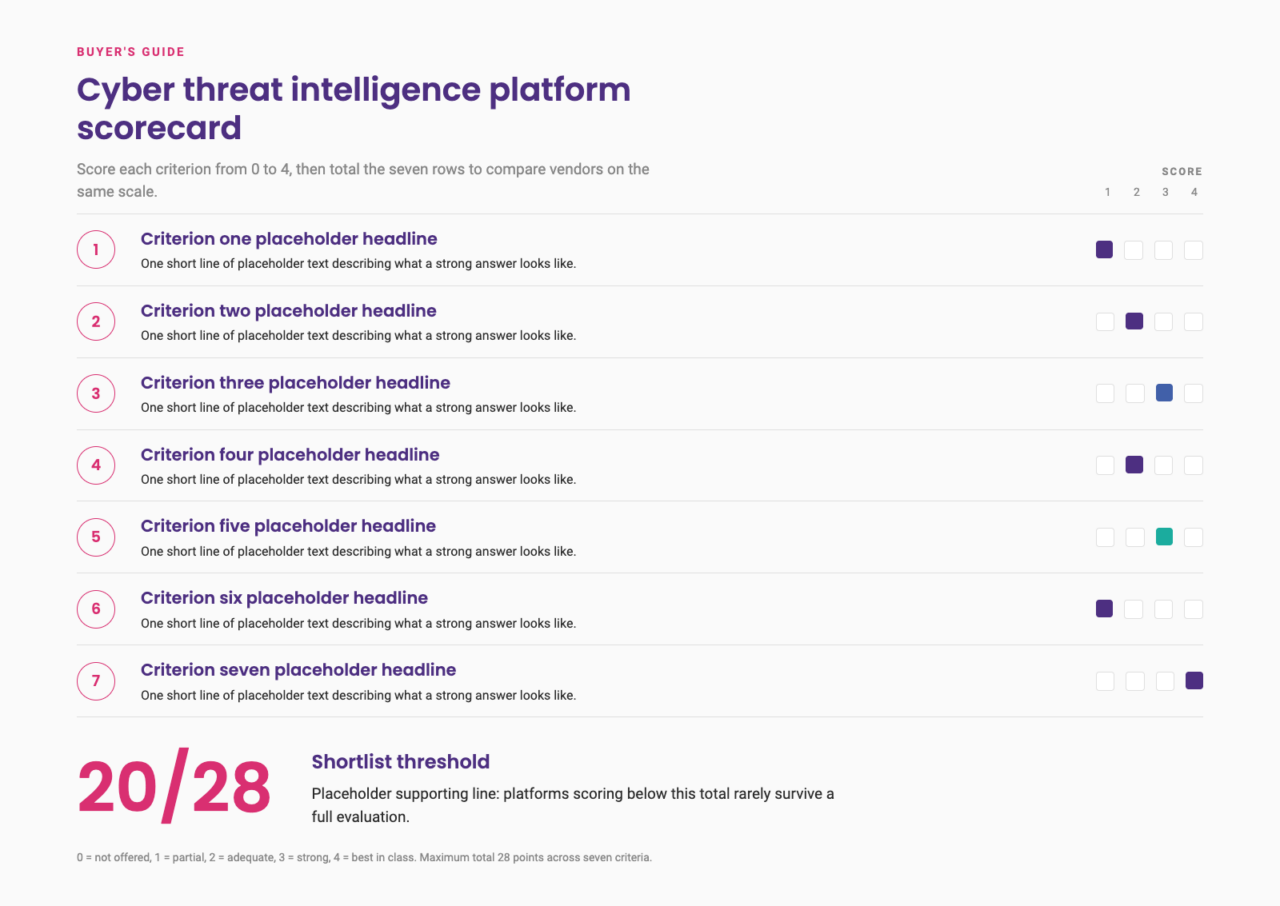
- Source diversity across open, deep, and dark web, named specifically
- Indicator freshness and a clear answer on decay
- Context and analyst-authored reporting, not automated output alone
- Curated intelligence (threat notes, actor profiles) as a real, demonstrated capability
- Supply chain and third-party coverage
- On-demand investigation capacity for urgent, specific questions
- Integration directly into SIEM, SOAR, or existing detection workflows
A vendor scoring below 20 of 28 is likely selling a feed with an intelligence label on it.
よくある質問
A feed delivers raw indicators, IP addresses, domains, file hashes, with little or no context. Cyber threat intelligence adds analysis: which threat actor or campaign an indicator is tied to, how relevant it is to a specific organization or industry, and what to actually do about it. A feed is an input. Intelligence is a usable output built from that input.
Because effectiveness measurement requires defining what success looks like before the program starts, and most programs get built around acquiring sources rather than defining outcomes. The SANS 2025 CTI Survey found only 55% of programs measure effectiveness at all, which tracks with a category that has historically been sold and bought on volume rather than demonstrated impact.
No. More sources without a way to prioritize, deduplicate, and contextualize them adds review burden without adding signal. The 2025 SANS data found lack of skilled staff cited as a primary roadblock by over a third of respondents, which is the practical constraint that makes uncurated volume actively counterproductive for most teams.
Open-source feeds provide a reasonable baseline but generally lack the freshness, context, and source diversity of a managed, analyst-supported platform, and require significant internal effort to curate and maintain. They’re a reasonable starting point, not typically a substitute for a program that includes analyst-authored context and supply chain visibility.
This guide evaluates the platform mechanics, feed quality, integration, and service breadth, that any cyber threat intelligence vendor should be judged on. The question of whether that platform is best delivered by an in-house team or a managed, analyst-led service is a separate decision, covered directly in CybelAngel’s guide to what managed threat intelligence actually delivers.
著者について