External Threat Intelligence Platforms: How to Evaluate Them in 2026 (Buyer’s Checklist)
Table des matières
In 2025, vulnerability exploitation became the number one way attackers got in, displacing stolen credentials for the first time in the nineteen-year history of Verizon’s Data Breach Investigations Report. Exploitation accounted for 31% of breaches against 13% for credential abuse. Breaches involving a third party reached 48% of the dataset, up from 30%. Organizations fully remediated just 26% of CISA Known Exploited Vulnerabilities, down from 38% the year before, at a median of 43 days each. And the average breach now costs $4.99 million, up 12% year over year.
Every external threat intelligence platform on the market will quote you numbers like those. Far fewer will tell you how their own output would have closed the window in any specific case. This guide compares seven platforms against the criteria that decide whether intelligence reaches a decision or dies in a queue: what each one collects, how it verifies what it collects, and what your team has to do before any of it becomes action.
Disclosure: CybelAngel wrote this guide, and CybelAngel competes with every vendor named in it. Two things follow from that. The seven platforms below appear in alphabetical order rather than ranked, and none of them is us. CybelAngel gets its own section further down, scored against the same criteria and given the same “where to press” treatment as everyone else. Skip to the rubric and the vendor questions if you’d rather ignore the profiles entirely, because those are the parts you can use against any vendor, including ours.
What we checked, and what nobody publishes
Every capability claim below comes from each vendor’s own public documentation, product pages, and press releases, verified in August 2026, plus reviewer commentary on Gartner Peer Insights where public material left a question open. Nothing here comes from a paid placement, a vendor briefing, or a competitive battlecard.
That method has a limit worth stating up front: public documentation tells you what a vendor chooses to publish. It cannot tell you a false-positive rate, an integration timeline, or an alert quality baseline. Those come out of a proof of concept against your own footprint, which is why this guide ends with instructions for running one instead of a verdict on who wins. Where a question stays unanswered in public material, we say so rather than filling the gap.
Seven platforms reviewed in full
| Plate-forme | Built for | Where to press hardest |
|---|---|---|
| Anomali ThreatStream | Managed operationalization of feeds you already buy | Which feeds it ingests, since its output inherits their quality |
| Flashpoint Ignite | Illicit community and fraud intelligence | False-positive handling and integration time, neither public |
| Google Threat Intelligence | Threat actor attribution inside Google SecOps | Integration outside the Google stack |
| Intel 471 | Underground access and adversary tradecraft | SIEM integration breadth and analyst workflow ergonomics |
| Recorded Future | High-volume automated collection at scale | Human escalation path for critical alerts |
| ThreatConnect | Orchestrating multiple intelligence sources | That it’s a platform layer, not an intelligence source |
| ZeroFox | Brand abuse, impersonation, executive exposure | Validation methodology and depth of technical feeds |
Anomali ThreatStream
Anomali positions ThreatStream as managed intelligence as a service, aggregating commercial and open-source threat feeds, applying scoring, and surfacing high-priority indicators through automated enrichment. The pitch targets analyst fatigue directly: fewer raw indicators of compromise (IOCs) reaching a human, more context attached to the ones that do.
Like ThreatConnect, Anomali sits at the operationalization layer rather than the collection layer, so its output quality is bounded by the feeds it ingests. Buy it expecting a collection source and you’ll be disappointed; buy it to reduce triage load on intelligence you already pay for and the value proposition is coherent. Public pricing detail is limited, and a direct coverage comparison against a collection-first vendor isn’t possible from public material.
Best for: Mid-market to enterprise teams with a defined SOC workflow and existing feed subscriptions, looking to cut alert fatigue through managed triage.
Flashpoint Ignite
Flashpoint built Ignite around intelligence from illicit communities: dark web forums, criminal marketplaces, and closed channels where threat actors coordinate. Coverage extends across vulnerability intelligence, fraud intelligence, and physical security risk alongside cyber threat intelligence, and the fraud depth is the clearest reason buyers shortlist it.
The gap for a structured evaluation is comparative substance. Public material doesn’t let you assess false-positive rates or how long integration actually takes, so a proof of concept against your own footprint is the only way to compare Flashpoint meaningfully against Intel 471 or Recorded Future on the dimensions your SOC cares about.
Best for: Organizations with significant fraud exposure or a need for deep illicit community intelligence, particularly financial services and retail.
Google Threat Intelligence
Google Threat Intelligence combines Mandiant’s incident response expertise, VirusTotal’s malware and IOC database, and Google’s own internet-scale visibility into one offering aligned with Google SecOps. The authority is real: Mandiant’s threat actor tracking and campaign attribution rank among the most respected work in the industry, and VirusTotal is infrastructure the whole industry already uses.
Two things to weigh. The platform leans toward enrichment and detection rather than proactive external exposure discovery, so it does less to find your misconfigured cloud storage or your leaked credentials than a vendor built for that job. And integration quality drops off outside the Google stack, so if you’re not running Chronicle, scrutinize that specifically rather than accepting the general integration story. Pricing requires a sales conversation at most tiers.
Best for: Organizations already on Google SecOps that want threat actor attribution and malware intelligence native to their detection workflow.
Intel 471
Intel 471 works from inside the criminal underground, combining human intelligence collection by native-language analysts with patented malware emulation to produce pre-attack signal on actors, campaigns, and marketplaces. The platform, now called Verity471 after evolving from TITAN, splits into Intelligence, Exposure, and Hunt modes, and the vendor added two AI capabilities, MCP471 and Agent471, in July 2026.
Underground depth is the reason to buy it, not breadth of exposure discovery. Reviewers on Gartner Peer Insights flag limited SIEM integration coverage and a threat hunting workflow that pushes analysts back into raw data more often than they’d like. Press hard on which of your specific tools have documented, tested integrations.
Best for: Mature CTI programs with dedicated analysts who want adversary tradecraft and pre-attack signal, and have the capacity to operationalize it themselves.
Recorded Future
Recorded Future is the most recognizable name in the category, built on automated real-time collection across open, deep, and dark web sources, covering vulnerability intelligence, digital risk, third-party risk, and payment fraud. The API and integration ecosystem is well documented, and MITRE ATT&CK integration through STIX, the machine-readable format for exchanging threat intelligence, is standard at the enterprise tier.
Two buyer-grade notes. Mastercard completed its $2.65 billion acquisition of Recorded Future in December 2024, which means the roadmap now serves Mastercard’s strategic priorities, and the payment fraud emphasis reads as direction rather than coincidence. Separately, the marketing leans on automation narratives more than managed analyst depth, and public documentation doesn’t disclose false-positive handling methodology. If your team needs a human escalation path on a critical alert at 2am, verify that capability by name and get the service level in writing.
Best for: Large SOC teams with the technical maturity to operationalize high-volume feeds and the analyst capacity to triage at scale.
ThreatConnect
ThreatConnect is a threat intelligence platform (TIP) in the operational sense. It aggregates, normalizes, and orchestrates intelligence from multiple external sources into SOC workflows, with STIX and TAXII ingestion as a core capability. For a team running intelligence from four providers and needing one operational layer over all of it, that’s the job it does well.
The trade-off is unambiguous, and ThreatConnect states it clearly: this is not an intelligence provider. It’s the layer that makes providers work together, and it demands technical maturity to operationalize. Buyers who conflate TIP functionality with external threat intelligence coverage end up having bought plumbing and no water. Evaluate it as a complement to a collection source, never as a substitute for one.
Best for: Enterprise SOC teams managing multiple intelligence feeds who need orchestration and structured workflow automation.
ZeroFox
ZeroFox organizes around a discover, validate, disrupt workflow, with brand protection as the clear strength: fake domains, impersonation accounts, social media fraud, and executive exposure. The interface makes it accessible to business risk teams who don’t come from a technical SOC background, which matters more in practice than it sounds.
Haveli Investments took ZeroFox private in May 2024 in a $350 million all-cash deal, so factor private equity ownership into how you read roadmap commitments over a three-year contract. On capability, public material doesn’t explain validation methodology or noise reduction mechanics in enough detail to evaluate false-positive handling objectively, and teams needing deep technical IOC feeds or SIEM enrichment at enterprise scale will find the platform narrower than alternatives here.
Best for: Brand-heavy organizations in retail, media, and financial services prioritizing anti-impersonation, domain takedown, and executive digital risk.
Where CybelAngel fits, and where it doesn’t
Held to the same standard as the seven above. CybelAngel detects what attackers see outside your perimeter: exposed data, compromised credentials, vulnerable APIs, and dark web signals tied to your specific footprint.
On collection, the platform scans more than 4.3 billion IPs daily for exposed data, processes 6 billion data points per day for credential intelligence, and monitors 10 million new dark web posts, 600,000 new discussions, and 125,000 new threats monthly across forums, Telegram, WhatsApp, IRC, and Discord for surveillance du dark web. The gestion de la surface d'attaque module discovers publicly exposed GraphQL and REST API endpoints with active testing mapped to OWASP Top 10 risks including SQL injection and cross-site scripting.
On output, each incident report carries a severity score, incident origin, and authenticated document samples, and credential alerts include clear-text pairs, IP associations, extraction dates, and platform URLs. CybelAngel states zero false positives on credential detections. Treat that the way you should treat any vendor’s accuracy claim, including this one: ask how it’s measured, over what period, and what counts as a positive. A number without a methodology is marketing.
On remediation, CybelAngel’s service reports reducing average time-to-containment from 77 days to 11 and lowering incident response costs by up to 10%, based on Ponemon research. Risk and threat assessments run entirely from an external perspective without touching target systems, which suits M&A due diligence and third-party risk.
Where to press us. CybelAngel is not a TIP: if you need to normalize and orchestrate four other vendors’ feeds through one workflow layer, ThreatConnect or Anomali does that job and we don’t. We’re not a SIEM-native enrichment play the way Google Threat Intelligence is inside Chronicle. And on malware reverse engineering and named threat actor attribution, Mandiant and Intel 471 go deeper than we do; our strength sits in exposure detection and verified takedown, not adversary profiling.
Best for: Enterprise teams that need external exposure coverage, analyst-verified alerts, and takedown support in one place, particularly in regulated environments aligning to NIS2, DORA, or NIST CSF 2.0.
The rubric that makes vendors show their work
Most comparison content stops at feature lists. Score each platform 1 to 5 on these eight criteria and the vendors have to show their work.
| Criterion | What a good answer sounds like | Score (1–5) |
|---|---|---|
| Coverage depth | Named source types matched against your actual external footprint, not “the internet” | |
| Data freshness | A stated detection latency with evidence behind it, not “real-time” | |
| Verification approach | Human triage, confidence scoring, deduplication, and a measured false-positive rate | |
| Report quality | Origin, severity, authenticated samples, and remediation guidance per incident | |
| Integration readiness | Documented connectors for your specific tools, plus time to first automated alert | |
| Analyst services | On-demand investigations and a named escalation path with a service level | |
| Remediation support | Vendor owns takedown, with a stated effect on time-to-containment | |
| Pricing transparency | Every axis disclosed: modules, assets, API limits, seats, investigation caps |
Two criteria carry more weight than their share of the total. Verification approach determines whether volume becomes intelligence or alert fatigue, and integration readiness determines whether any of it reaches a workflow. A platform scoring 5 on coverage and 2 on those two is a data subscription your team pays to ignore.
Nine key questions
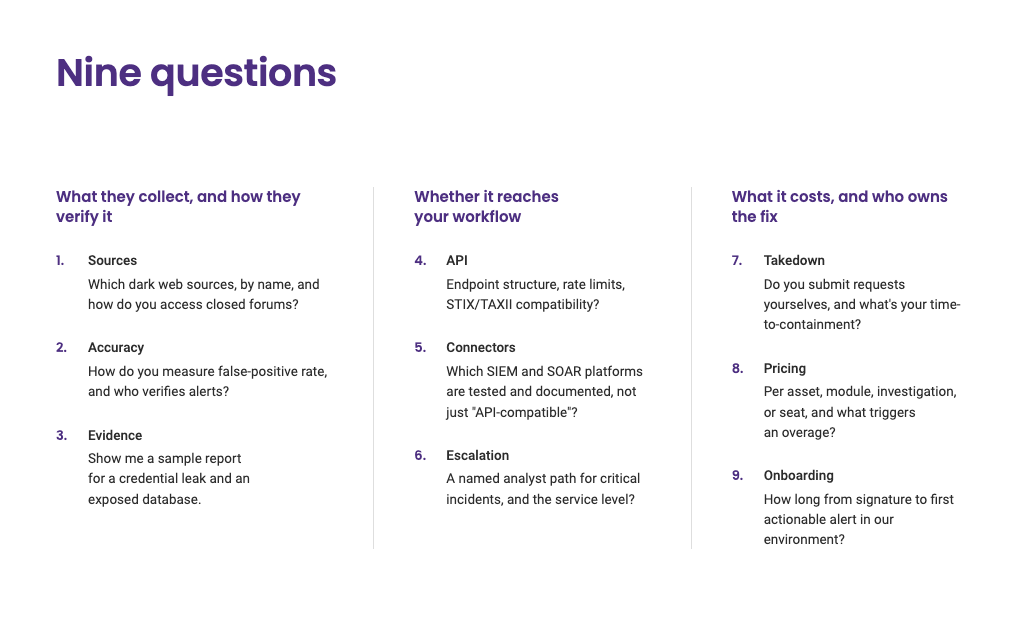
Get specific answers to these before a demo turns into an RFP:
- Which sources are in your dark web coverage by name, and how do you access closed forums?
- How do you measure false-positive rate, and what’s the verification process per alert type?
- Show me a sample incident report for a credential leak and one for an exposed database.
- What’s the API endpoint structure, the rate limits, and your STIX/TAXII compatibility?
- Which SIEM and SOAR platforms have tested, documented integrations, not just “API-compatible”?
- Is there a named analyst escalation path for critical incidents, and what’s the service level?
- Do you submit takedown requests yourselves, and what’s your average time-to-containment?
- Is pricing per asset, per module, per investigation, or per seat, and what triggers an overage?
- How long from signature to first actionable alert in our environment?
The pricing question matters more than it looks. Total cost of ownership surprises in this market usually come from an axis nobody asked about: investigation caps, API call limits, or per-seat scaling that only bites in year two.
Dataset size is not your decision point
What decides this is how intelligence becomes action in your specific environment.
If your SOC has limited capacity, you need managed CTI rather than raw feeds. Managed CTI means the vendor handles collection, enrichment, and analyst-led contextualization, so your team receives finished intelligence instead of a data dump to process. A high-volume feed platform hands a two-person team more work, not less.
If your SOC is large and technically mature, you probably need both layers: high-volume feeds with STIX/TAXII ingestion for automation, plus a managed layer for analyst escalation on critical incidents. A TIP orchestrates the feed layer while a collection-first provider produces the verified external signal.
If you’re in a regulated or critical sector, documented external assessment outputs matter as much as real-time alerting, because an auditor reads reports rather than dashboards.
If you’re doing M&A or third-party risk, you need fast external assessment of a target’s footprint without system access. That’s a specific capability rather than a standard feature, so verify it explicitly instead of assuming the platform covers it.
Two weeks of proof beats two months of demos
Run a proof of concept before signing anything, and give every vendor the same inputs: your live domain portfolio, a list of VIP executives, and a set of exposed assets you already know about. That last one is the control. A vendor that misses a known exposure has told you something no reference call will.
Then compare four things across vendors: match rate against your known set, confidence and evidence attached to each finding, false positives you had to dismiss, and how many clicks it took to get from alert to a remediation step someone could actually execute.
If an auditor will read this, add one question
If you report under NIS2, DORAou NIST CSF 2.0, ask how the platform’s output maps to your specific reporting obligation. NIS2 Article 23 incident reporting, DORA’s ICT risk framework, and the govern and respond functions of NIST CSF 2.0 each expect evidence in a particular shape, and a dashboard screenshot rarely satisfies an auditor.
Financial institutions running TIBER-EU style assessments have a further constraint. The framework, published by the ECB in May 2018, requires threat intelligence gathered from an external perspective without touching target systems. Verify that a vendor can work under that constraint before scoping the engagement, because retrofitting it later means starting over. For the compliance mapping side, see regulatory cyber compliance.
FAQ
An external threat intelligence platform collects and analyzes threat signals from outside your perimeter, then delivers them to your security team as prioritized intelligence. Coverage typically spans the open, deep, and dark web, exposed cloud storage and connected devices, leaked credentials, brand abuse, and internet-facing assets. The distinction from internal tooling is the vantage point: it starts from what an attacker can see, rather than from telemetry your own systems produce.
A threat intelligence platform (TIP) such as ThreatConnect or Anomali aggregates, normalizes, and orchestrates intelligence from other sources into your workflows. An external threat intelligence provider produces the intelligence in the first place through its own collection. Buying a TIP expecting coverage leaves you with orchestration and nothing to orchestrate. Many mature programs run both layers deliberately.
Nearly every vendor in this category prices through a sales conversation rather than a public list. Cost scales along several axes at once: modules licensed, assets or domains in scope, API call limits, seat counts, and investigation caps. Ask which axes apply and what triggers an overage, because total cost of ownership surprises usually come from an axis nobody asked about during evaluation.
Don’t take a published figure at face value, including a favorable one. Ask how the vendor defines a positive, over what period the rate is measured, and whether human analysts validate alerts before delivery. Then test it yourself: during a proof of concept, count the alerts your team dismissed and divide by total alerts received. That number, from your own footprint, is the only one that describes what your team will experience.
Yes, because they see different things. A SIEM correlates telemetry from systems you control and own. External threat intelligence finds exposure on infrastructure you don’t: a supplier’s misconfigured storage, credentials for sale on a forum, an API endpoint nobody documented. The SIEM tells you what happened inside; external intelligence tells you what an attacker can already see from outside.
No single platform wins for every buyer, and any vendor claiming otherwise about its own product should be discounted for it. The right choice depends on your SOC’s capacity to triage, your existing stack, whether you need brand protection or underground intelligence or exposure discovery, and whether you need someone to own takedown. Score your shortlist against the eight criteria above and the answer resolves differently for a two-person team than for a 40-analyst SOC.
The right external threat intelligence platform for your organization in 2026 isn’t the one with the largest dataset. It’s the one that converts signal into verified, actionable intelligence at the speed and scale your program can absorb. Score your shortlist, run the proof of concept with your own domains, and let the match rate settle the argument.
Evaluating one category at a time? Our gestion de la surface d'attaque, prévention des violations de donnéeset surveillance du dark web buyer’s guides each go deeper on their own criteria.
À propos de l'auteur