Le coût de l'inaction : l'usurpation d'identité sur les réseaux sociaux en chiffres
Table des matières
In the spring of 2026, a major regional bank discovered it had been impersonated across five social media accounts with a combined reach of 45,000 followers. The fraudulent domain had been live for five minutes before an alert was issued. By the time the bank’s security team had been briefed, customers were already losing money.
The bank is not an outlier. It is an illustration of how impersonation attacks now operate: at registration speed, across platforms most enterprise security teams do not monitor, and well within the window that manual platform reporting cannot close.
Fake accounts do not file themselves under fraud. They surface in brand monitoring dashboards, get reclassified as a communications issue, and settle into a queue that moves at marketing speed. By the time anyone with security authority and the tooling to act sees them, the wire transfer has cleared, the credentials have been harvested, or the scam has run its natural course.
This is not a process failure. It is a classification failure, and the cost of getting it wrong is measurable, accelerating, and distributed across finance, legal, HR, and security teams right now, whether or not a single ticket has been raised. In January 2026, a single JavaScript pivot uncovered 30,882 unique domains running the same task scam kit simultaneously across Telegram, Instagram, Facebook, and TikTok. Not one element of that infrastructure touched LinkedIn or X, the two platforms most enterprise security teams actually watch.
The attacker’s window is 20 days. Your team finds out on day 14.
Twenty days is not a worst-case scenario. It is the average resolution time when a takedown goes through standard platform reporting. Here is the event sequence that plays out while the queue processes.
| Timeline | What is happening to your organisation |
|---|---|
| Day 0 | Fake domain or account registered. Your security stack sees nothing. |
| Day 1-2 | Phishing kit live. Customers, candidates, and finance team members targeted. Credentials and funds begin moving. |
| Days 3-14 | Internal alert fires, if it fires at all. Ownership disputed between security, brand, and legal. Ticket created. No one has authority to act fast enough. |
| Days 14-19 | Manual takedown filed to Meta, TikTok, or X general queue. Joins a backlog shared with millions of other submissions. |
| Day 20 (average) | Takedown confirmed. Attacker has rebuilt on new infrastructure. Campaign restarts. |
The problem is not the speed of the filing. It is the gap between when an attack launches and when anyone with authority to act knows it exists. Faster manual filing does not close that gap. It compresses the back end by a day or two while the attacker runs uncontested through the period that matters.
In May 2026, CybelAngel flagged a fraudulent domain impersonating a major regional bank five minutes after it was registered. The campaign had already seeded five social accounts with a combined reach of 45,000 followers. By day three, the attacker had been forced to dismantle and rebuild their entire infrastructure from scratch. Twice. That is the operational difference between detection at registration speed and detection at queue speed.
“Treating impersonation as a brand problem is a budget decision disguised as a classification decision. The financial exposure lands on security, legal, finance, HR, and customer success. The invoice just does not say impersonation at the top.”
Six costs that never appear in an incident report
Wire transfer losses and regulatory fines are visible and quantifiable. These accumulate silently across departments and compound for months after the takedown is confirmed.
- Legal exposure your legal team has not priced in yet. Le FTC Government and Business Impersonation Rule carries penalties up to $53,088 per violation and has been in force since April 2024. The UK Online Safety Act, enforced by Ofcom from March 2025, scales to 10% of worldwide revenue. Australia’s Scams Prevention Framework Act, passed February 2025, reaches AUD $50 million per offence. All three frameworks now expect brands to actively monitor and act. Passive monitoring is not a compliant posture in any of these jurisdictions, and that is a board-level conversation your legal team needs to initiate before the next audit cycle.
- Candidate pipeline damage that never recovers cleanly. Recruitment fraud via fake LinkedIn profiles rose 237% year-on-year in 2025, according to Lloyds Bank. Candidates burned by a fake recruiter using your name do not apply again. They tell peers. Talent acquisition costs are already high. Impersonation makes the reputational damage permanent in a way that no retraction corrects.
- Operational overhead that lands in the wrong teams’ inboxes. HR fields calls from task scam victims who believe they just lost their savings to your company. Customer support handles refund demands from people defrauded by a platform built on your visual identity. Finance reviews wire transfers initiated by a cloned CFO profile. None of this generates a CISO incident report. All of it costs real hours across teams that were not resourced to absorb fraud response.
- Brand trust erosion with no recovery curve. Selon la Telesign 2025 Trust Index, 64% of consumers say their perception of a brand suffers after a fraud encounter, even when the brand was the one being impersonated. The attacker collects the proceeds. You carry the reputational liability indefinitely.
- Presence dilution that poisons your own campaigns. As fake profiles accumulate, your authentic communications start getting flagged as suspicious by the audience you are trying to reach. Real recruitment posts look like scams. Real support accounts look like the fakes. The damage compounds without generating a single incident report and without any external trigger to stop it.
- Recurrence you are not monitoring for. Attackers rebuild. The May 2026 case showed an operator reconstructing their full infrastructure from scratch within 72 hours of the first takedown confirmation. Without 30-day post-takedown monitoring and SOC intelligence integration, the same campaign relaunches under a new domain while your team treats the previous incident as closed. Domain impersonation at enterprise scale costs organisations millions precisely because the incident lifecycle does not end at takedown.
Your monitoring has a structural blind spot. Here is why it is not your team’s fault.
Most enterprise security stacks were built around LinkedIn and X. That was the right call five years ago. Attackers adapted their distribution infrastructure to exactly the platforms where enterprise monitoring is weakest. The stack did not follow.
Platform compliance compounds this. TikTok is currently the least compliant platform for takedown requests. Instagram and Facebook compliance is declining. WhatsApp and Telegram offer no meaningful formal compliance pathway. Attackers route victim management into encrypted Telegram channels specifically because they know that once a victim is inside a handler group, the intervention window has closed. Detection at the domain and social layer has to happen before that transition. By the time a victim is receiving daily task instructions from a fake supervisor displaying your branding, manual filing to a platform queue is irrelevant.
The signal-to-noise problem makes this operationally unmanageable without analyst verification. In a 2025 large enterprise client case, CybelAngel processed 24,163 raw detections across all monitoring modules and delivered 182 qualified incident reports. That is a 99.2% reduction before a single alert reached the client’s inbox. An unverified tool that delivers raw detections directly to your team does not solve the impersonation problem. It creates a second one: alert fatigue that buries critical incidents inside thousands of low-priority flags, and trains analysts to deprioritise the queue that contains the real exposure.
What CybelAngel does that your current stack cannot replicate
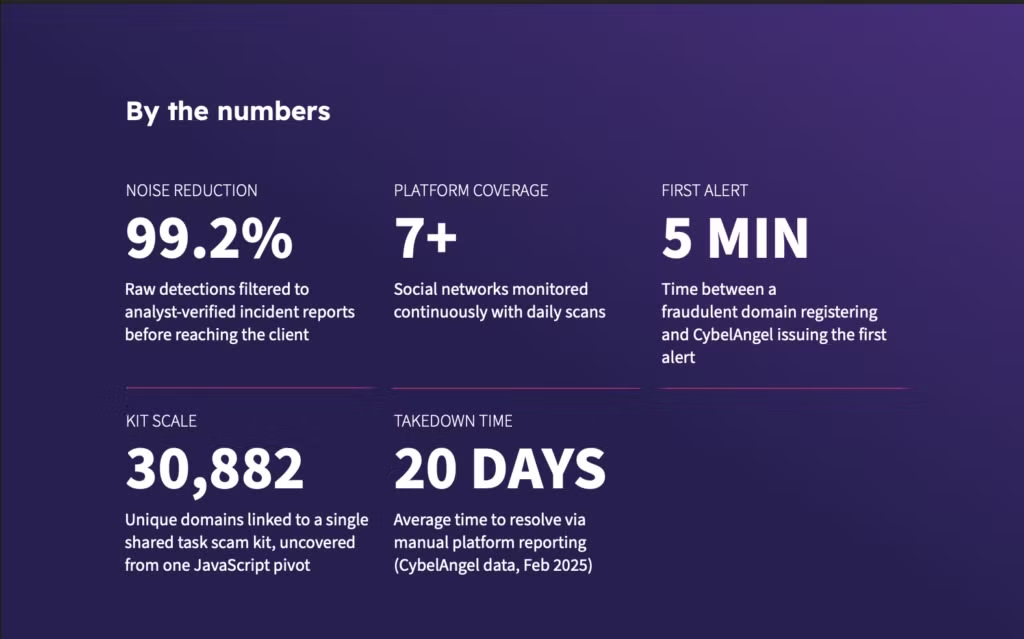
Detection at registration speed, not reporting speed. CybelAngel monitors 7 social networks with daily scans and domain registration feeds. In the May 2026 bank impersonation case, the fraudulent domain was flagged five minutes after registration. That is not a benchmark figure. It is the timestamp on the alert from a confirmed incident. Speed of detection is the only variable that materially compresses the attacker’s operating window before funds move.
Analyst verification before anything reaches your team. Every detection is reviewed by a CybelAngel analyst before it becomes an incident report. Reports arrive with the exact profile URL, timestamp screenshots, platform metadata, the specific platform policy violated, and a severity score with analyst reasoning. This is the complete package a takedown request needs to succeed quickly. Missing any element adds days to platform processing. The analyst assembles it before the alert leaves the platform.
Automated takedown routing calibrated to current platform compliance. Major and critical severity incidents trigger takedown requests automatically. Submissions are routed through the correct channel for each platform’s current compliance posture, not a generic queue. For Meta, X, TikTok, YouTube, LinkedIn, and Reddit, that means enterprise support channels where available. Standard form submissions for major incidents are not viable. Platform compliance postures are actively declining across the channels attackers prefer. The routing has to reflect that reality, not historical defaults.
Recurrence monitoring and SOC intelligence integration post-takedown. CybelAngel monitors for recurrence for 30 days after every confirmed takedown and feeds intelligence back into your SOC as an upstream phishing signal. Fake recruiter clusters are a documented upstream indicator for credential phishing campaigns. The investigation does not end when the platform confirms removal. It ends when the attacker’s infrastructure is confirmed dismantled and not rebuilt.
The questions security leaders actually ask in vendor evaluations
In May 2026, a fraudulent domain targeting a regional bank’s customers was live for five minutes before CybelAngel issued an alert. In those five minutes, the campaign had already seeded five social accounts with 45,000 combined followers. The CISO question is not whether impersonation is a brand problem or a security problem. The question is which team has the tooling, authority, and response speed to close a 20-day attacker operating window before six-figure fraud losses clear and before three regulatory frameworks treat inaction as non-compliance. Brand teams do not. Security teams do. That is the budget conversation.
In January 2026, 30,882 unique domains running the same coordinated task scam kit operated simultaneously across Telegram, Instagram, Facebook, and TikTok. Zero of that infrastructure touched LinkedIn or X. TikTok is the least compliant platform for takedowns right now. Instagram and Facebook compliance is declining quarter-on-quarter. WhatsApp and Telegram have no meaningful formal compliance pathway. Your monitoring covers the two platforms attackers already know you watch. The remaining six are where campaigns actually run, where victims are recruited, and where handler infrastructure operates without interference.
Continuous monitoring across 7 social networks with daily scans, combined with domain registration feed monitoring and JavaScript fingerprinting at the infrastructure level. When a domain or account matches brand signals, it triggers analyst review before generating an alert. The analyst produces the complete takedown package: exact URL, timestamp screenshots, platform metadata, policy violation mapping, and severity score. For major and critical incidents, the submission fires automatically through platform enterprise channels. Without analyst verification, a large enterprise generates 24,163 raw detections. With it, your team acts on 182 qualified incident reports. The difference is not convenience. It is whether your analysts can find the critical incident before the attacker’s operating window closes.
The FTC Government and Business Impersonation Rule has been in force since April 2024 at $53,088 per violation. In year one: five cases brought, 13 impersonation websites shut. UK operations add Online Safety Act exposure at up to 10% of worldwide revenue, enforced by Ofcom from March 2025. APAC operations add Australia’s Scams Prevention Framework Act at AUD $50 million per offence, passed February 2025. All three frameworks now expect organisations to monitor and act proactively. We did not know is not a compliant posture in any of these jurisdictions, and none of them distinguish between intentional inaction and capability gaps.
Our analysts run the detection against your brand in the demo environment and show you what is currently active across all seven monitored networks: live fake accounts, impersonating domains, executive profile clones, task scam infrastructure using your name and visual identity. You see your actual exposure, not a simulated environment. You see how it bypassed your current monitoring. You see the complete takedown workflow from first alert to confirmed infrastructure teardown. If there is nothing active against your brand, we tell you that. Most organisations find something in the first session. The ones that do not are in a minority that is shrinking quarterly.
À propos de l'auteur