Credential Intelligence Tools: 2026 Buyer’s Checklist
Tabla de contenido
Verizon’s 2026 Data Breach Investigations Report contains a finding that looks, at first read, like bad news for anyone selling credential monitoring: stolen credentials fell to 13% as a standalone initial-access vector, overtaken for the first time in the report’s 19-year history by vulnerability exploitation at 31%. If credential theft mattered less last year, why evaluate a tool built around it?
The same report answers that question two pages later. Credential abuse across full breach chains, not just as the opening move, is still present in 39% of breaches, described in Verizon’s own analysis as the single most pervasive technique in the dataset. More specifically: 50% of ransomware victims had a credential or infostealer event within 95 days before the ransomware attack itself hit. Credentials didn’t stop mattering. They stopped being the opening move as often, and started being the early warning sign that something worse is already 95 days out.
That’s the distinction this guide is built around, and it’s also the reason a raw feed of exposed credentials isn’t the same product as credential intelligence. Anyone can show you a password that leaked. The useful question is whether a vendor can show you that pattern early enough, and verified enough, to act on before the 95 days run out.
The cost of waiting for the credential to get used
IBM’s 2025 Cost of a Data Breach Report puts credential-based breaches at $4.67 million on average, above the $4.44 million global mean, and 246 days to identify and contain, also above the global average of 241 days. The reason is structural, not a failure of any particular team: a valid login doesn’t trip the alarms a malware infection does. Nobody’s antivirus flags a real password being used correctly.
Verizon’s infostealer-specific data sharpens the timeline further. Infostealers are now surfacing an average of 2,362 breached corporate credentials per month from organizational email domains, and 54% of devices in Initial Access Broker logs had at least one infostealer installed. That’s not a rare event happening to unlucky organizations. It’s a standing, monthly volume, and the 95-day ransomware-correlation window means the credentials sitting in that volume right now are a genuine early-warning system, if something is actually watching for them.
Why this is a different category from dark web monitoring and data breach prevention
If you’ve read CybelAngel’s Dark Web Monitoring buyer’s guide or Data Breach Prevention buyer’s guide, this distinction matters more than it might seem to on first read, since the three categories genuinely overlap in places.
Dark Web Monitoring covers forums, marketplaces, and dark web communities broadly, any threat activity referencing your organization, not specifically credentials. Data Breach Prevention covers documents and files exposed outside your perimeter, on connected storage, cloud applications, and databases, not specifically login credentials either. Credential Intelligence is narrower and more specific than both: it’s built around detecting exposed usernames, passwords, session tokens, and the personally identifiable information that makes a credential exploitable, sourced through three distinct methods, infostealer malware interception, dark web and breach database monitoring, and paste site tracking, then graded by a human analyst before it reaches your team.
A tool that only watches dark web forums will miss a credential an infostealer harvested off an employee’s laptop before it ever reaches a marketplace. A tool that only watches for exposed documents will miss a stolen session cookie entirely, since a cookie is stolen identity state, not a file sitting on a server. Evaluating these as one undifferentiated “monitoring” category is how buyers end up with three overlapping subscriptions and gaps between all of them.
The 7-point evaluation checklist
1. Does it detect session tokens and cookies, not just passwords?
A stolen session cookie can grant account access without ever triggering an MFA prompt, since the login already happened once and the token proves it. Recorded Future’s tracking puts 276 million currently indexed credentials, out of 1.95 billion total, at including an active session cookie capable of bypassing MFA on import. A tool scoped to passwords alone misses this category of exposure entirely. Ask specifically whether session tokens are a detected category, not just a mentioned one.
2. Does it cover both employee and customer credentials?
Employee credential exposure and customer credential exposure are different risk categories with different remediation paths, an employee credential resets through IT; a customer credential requires forcing a password reset at scale without triggering a support-line flood. A vendor that only covers one half of this is only solving half the problem, particularly for consumer-facing organizations where customer account takeover is a direct financial and reputational risk, not just an internal security one.
3. Does detection include infostealer interception, not just post-sale monitoring?
Waiting for a credential to appear for sale on a marketplace means waiting until the sale has already been offered to however many buyers found the listing first. Interception at the infostealer stage, before the harvested credentials are packaged and distributed, closes a meaningfully earlier part of that 95-day ransomware-correlation window than marketplace monitoring alone.
4. Is every alert human-verified before it reaches your team?
CrowdStrike’s 2026 Global Threat Report found 82% of 2025 intrusions were malware-free, relying on stolen credentials and legitimate tools rather than a dropped file, which means the credential alert itself has become the primary signal security teams need to trust. A raw match against a leaked database is not the same as a verified finding. Ask what percentage of alerts get reviewed by an analyst before delivery, and what the false-positive rate looks like in practice, not just in marketing copy.
5. Does it grade severity, not just report volume?
Not every exposed credential carries the same risk. A stale password for a decommissioned account and an active session token for a finance-system administrator are not the same finding, and a tool that reports both with equal weight is asking your team to do the triage work the tool should be doing. Look for graded reporting: severity, account type, and system access scope, not an undifferentiated list.
6. What’s the remediation path once a credential is confirmed?
Detection without a fast reset path is a delayed alert, not a solved problem. Ask specifically how credential resets are triggered, whether the vendor integrates with your identity provider to force a reset automatically or whether that step is manual, and what the average time is between confirmed detection and reset completion.
7. How does it handle the volume problem?
At 2,362 breached corporate credentials surfacing per month on average, a tool that can’t prioritize is a tool that generates a queue nobody clears. Ask how findings are ranked, and get a straight answer on whether that ranking is rules-based, model-based, analyst-reviewed, or some combination, since the honest answer to “how do you prioritize” tells you more about a vendor than almost anything else on this list.
The buying committee
Credential Intelligence decisions typically involve more stakeholders than a single security tool purchase, because the remediation side touches identity and access management directly, not just detection:
- CISO or Head of Security: owns the risk case and the vendor relationship
- Identity and Access Management lead: owns the reset and enforcement mechanics once a credential is confirmed
- SOC or security operations lead: owns day-to-day alert triage and will be the one living with the false-positive rate
- Legal or compliance: relevant wherever customer credential exposure creates a notification obligation, not just an internal one
What a real demo should show you
A vendor demo built around a hypothetical exposure tells you nothing about how the tool performs against your actual footprint. Ask for a demo scoped to your own domain, showing:
- What’s currently indexed against your organization right now, not a canned example
- How a finding is graded, and what the severity levels actually mean in practice
- The path from detection to reset, walked through step by step, not described in the abstract
- What a false positive looks like when one occurs, and how it gets flagged as such
Pricing and what actually drives it
Credential Intelligence pricing typically scales on domain count, employee and customer volume, and the depth of infostealer-source coverage rather than a flat per-seat model. The questions worth asking directly: does pricing change based on findings volume (a perverse incentive structure if a vendor’s revenue rises when your exposure does), and is remediation support (the reset workflow, not just the alert) included or billed separately.
Implementation timeline
Domain and identity-provider connection typically takes under a business day. The meaningful timeline is the tuning period, roughly two to four weeks, during which severity thresholds and alert routing get calibrated to your organization’s actual risk tolerance rather than a vendor default. Ask what that tuning period looks like concretely, and who owns it, your team or the vendor’s.
An illustrative example, not a client case study
CybelAngel doesn’t have a named, public credential-intelligence case study to point to the way the Dark Web Monitoring guide can point to Lagardère. Rather than manufacture one, it’s worth looking at the real, already-documented Vercel breach as an illustration of the pattern this category exists to catch: the intrusion traced back to a stolen OAuth token, itself exposed because an infostealer infected a completely unrelated third party’s employee months earlier. Vercel’s own perimeter was never touched. The exposure that mattered was a piece of stolen identity state sitting somewhere nobody at Vercel was positioned to see, exactly the category of finding infostealer-stage interception is built to catch before it reaches that point.
Common objections, and honest answers
“We already have dark web monitoring, isn’t this the same thing?”
Overlapping, not identical. Dark web monitoring watches forums and marketplaces broadly. Credential intelligence specifically targets exposed logins, session tokens, and PII, sourced partly from infostealer interception that happens before anything reaches a dark web marketplace at all. Running both closes a gap that running either alone leaves open.
“Credential abuse dropped in the DBIR, why invest here now?”
It dropped as a standalone entry vector. It’s still present in 39% of full breach chains and specifically predicts ransomware within a 95-day window. The risk didn’t shrink; the point at which it shows up in an attack shifted.
“Our employees use a password manager and MFA, isn’t that enough?”
MFA doesn’t stop a stolen session token, since the token proves an authentication event already happened. A password manager reduces reuse risk but does nothing once malware has already harvested credentials directly off a device.
“How is this different from just running our own breach-database searches?”
Public breach-database lookups only cover credentials that have already been compiled, published, and indexed elsewhere, typically well after the infostealer and initial-sale stages. Infostealer-stage interception and human-graded severity are the parts a manual lookup can’t replicate.
The scorecard
Score each vendor from 0 (not offered) to 4 (fully offered and demonstrated) on:
- Session token and cookie detection, not just passwords
- Employee and customer credential coverage, both
- Infostealer-stage interception, not just post-sale monitoring
- Human verification rate on delivered alerts
- Severity grading, not undifferentiated volume
- Remediation integration with your identity provider
- Clear, non-perverse pricing relative to findings volume
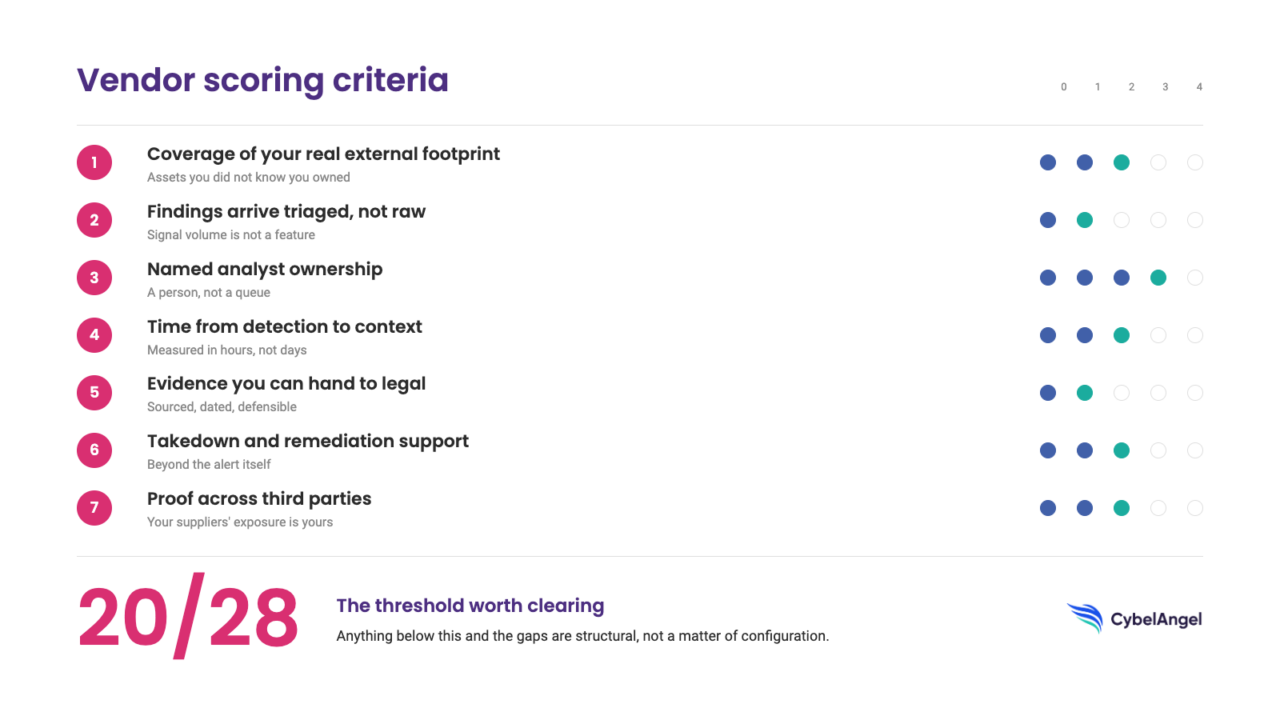
A vendor scoring below 20 of 28 is likely offering a feed, not intelligence.
Preguntas frecuentes
Dark web monitoring covers threat activity referencing your organization broadly, forums, marketplaces, general chatter. Credential intelligence specifically targets exposed logins, session tokens, and PII, sourced partly through infostealer interception that happens before anything reaches a dark web marketplace. The categories overlap but aren’t the same coverage.
Not as a risk, no. Verizon’s 2026 DBIR found credential abuse fell to 13% as a standalone initial-access vector, overtaken by vulnerability exploitation at 31%, but credential abuse remains present in 39% of full breach chains and specifically predicts ransomware: 50% of ransomware victims had a credential or infostealer event within 95 days beforehand.
A properly scoped one can. Session tokens and cookies are a distinct detection category from passwords, and Recorded Future’s tracking puts 276 million of the 1.95 billion currently indexed credentials as including an active session cookie capable of bypassing MFA on import. Ask any vendor directly whether this is a named, detected category.
It depends on the vendor and the deployment scope. Employee and customer credential exposure are different risk categories with different remediation paths, and a tool worth evaluating should cover both explicitly rather than assuming employee coverage is sufficient for a consumer-facing organization.
There’s no universal industry benchmark, but given that infostealers are surfacing an average of 2,362 breached corporate credentials per month and that credential exposure predicts ransomware within a 95-day window, the practical target is detection measured in hours to low days, not weeks.
No. Free lookup tools only cover credentials already compiled and published elsewhere, typically after the infostealer and initial-sale stages have already happened. They’re a useful sanity check, not a substitute for interception earlier in that timeline
Sobre el autor