The API Threat Report: What 2026 Has Taught Us So Far
Tabla de contenido
APIs are the glue that hold applications together. They power logins, payments, searches, and dashboards. (And often, without users even knowing they exist.) But as they’ve grown more powerful, they’ve also become a favorite target for attackers.
In 2026, that risk is more visible than ever. From stolen tokens to broken authorization, we’ve seen how quiet flaws in APIs can lead to major security incidents. This article breaks down the biggest API security risks so far this year. And not just in theory, but through real-world examples.
Introduction
Application programming interfaces (APIs) are designed to connect systems, enable features, and simplify complexity. But that same simplicity can hide serious security gaps, especially when APIs are left undocumented, misconfigured, or exposed to the public internet.
Unlike traditional web applications, API versions don’t always have clear front doors. Many don’t show up in security scans. Some are deployed quickly, tested loosely, and forgotten entirely. But for attackers, they’re ideal entry points.
This guide breaks down the top API security risks seen in real-world breaches this year. Whether you’re tracking broken authentication, excessive data exposure, or injection attacks, these incidents offer practical insight into how APIs are being abused. And how to stop it.
How we got here: The rise of the API attack surface
APIs used to function as internal tools. But as everything moved to the cloud, such as banking, payments, healthcare, and logistics, APIs became public-facing, interconnected, and exposed.
Now, they’re everywhere. In mobile apps, backend services, third-party integrations, and embedded inside microservices. With every new release or product launch, more APIs go live. And not all of them are tracked.
Security teams now face three core problems when trying to secure API processes:
- Discovery is hard: Many API vulnerabilities don’t show up in traditional scans. Some are undocumented or belong to forgotten projects. Others live in dev environments but still accept requests.
- Access control is inconsistent: Different teams manage different API endpoints. Some use API keys, others rely on outdated OAuth flows. Authentication mechanisms vary… or don’t exist at all. Which makes unauthorized access an easy attack vector.
- El attack surface keeps growing: More endpoints mean more potential entry points (and security vulnerabilities). Each one handles user input, permissions, and sensitive information differently. All of it becomes fair game to attackers.
This is why API security risks have moved to the top of the agenda.
API security threat examples in 2026
Let’s break down some real-life API security risks and trends observed in 2026.
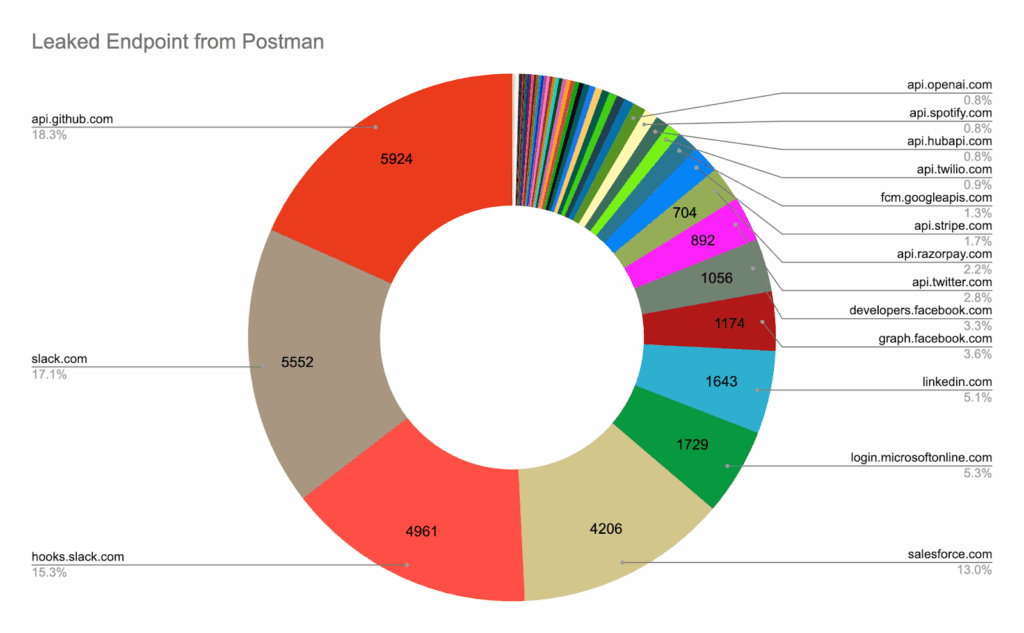
Postman workspace exposures leaked real API keys and sensitive data
- Overview: Investigations revealed that tens of thousands of public Postman workspaces exposed live API keys, access tokens, and sensitive payloads (including healthcare records and enterprise credentials).
- What went wrong: Many workspaces were publicly shared without security controls. Developers had saved real tokens, secrets, and request logs that were accessible to anyone with the link.
- Por qué importa: Postman is used across the API lifecycle, but it’s not designed as a secret manager. One exposed workspace can give attackers direct access to production systems.
Over 95% of enterprise organizations report API security incidents
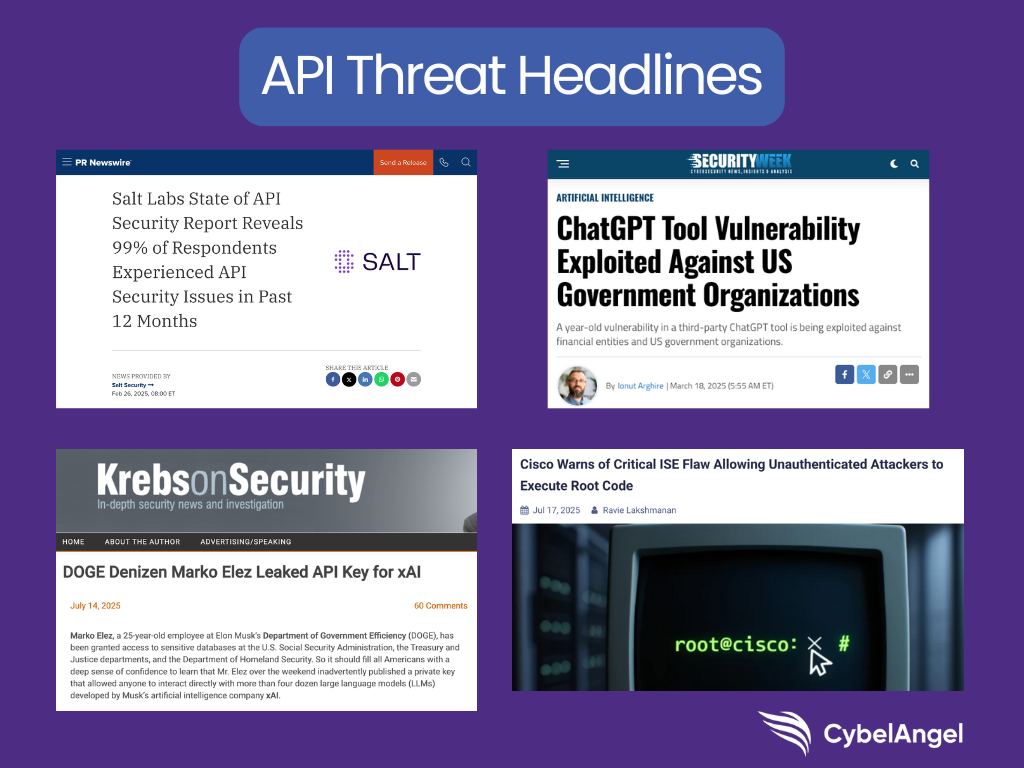
- Current Landscape: Recent industry studies show that over 95% of surveyed organizations experienced at least one API security issue over the past 12 months.
- Where the failures are: The top API security risks reported continue to be injection attacks and Broken Object Level Authorization (BOLA), which together make up a significant portion of all security incidents. Sensitive data exposure and broken authentication follow closely behind.
- What makes this worse: The vast majority of API attacks originate from authenticated sessions, proving that simply trusting access tokens is no longer enough. Almost all attacks targeted external-facing APIs. Alarmingly, only a fraction of organizations have an active posture governance strategy.
- Por qué importa: Poor governance and inconsistent API security standards are now slowing software rollouts across enterprises. Furthermore, code generated by generative AI tools is introducing unvetted API vulnerabilities into production environments.
Server-Side Request Forgery (SSRF) in AI tools
- Overview: Server-side request forgery (SSRF) vulnerabilities in third-party integrations and webhooks designed for LLMs and AI services continue to be targeted by threat actors.
- Where the failure lies: Improper validation allows attackers to inject crafted URLs into API parameters, redirecting backend webhooks to malicious endpoints or internal cloud metadata services without requiring authentication.
- What is exposed: Internal network resources, private API endpoints, and cloud instance metadata are placed at risk when proper egress firewalls and input sanitization are missing.
- Por qué importa: As organizations rapidly connect enterprise LLMs to external APIs, unvetted endpoints become high-priority entry points for automated exploit scripts.
Exposed secrets and hardcoded API keys in public repositories
- Overview: Automated scanning across public code repositories consistently reveals exposed production API keys, grant tokens, and database connection strings committed by developers.
- Where the failures occur: Secrets are frequently hardcoded inside scripts or configuration files during rapid deployment, bypassing automated pre-commit secret detection tools.
- What makes this worse: Leaked keys often remain valid even after public exposure because organizations lack automated key rotation and secret revocation workflows.
- Por qué importa: A single leaked API key can grant unauthenticated access to downstream APIs, exposing sensitive user records across cloud environments.
Critical authentication bypasses in network infrastructure APIs
- Overview: Flaws in management APIs for network gateways and identity engines allow unauthenticated attackers to execute arbitrary code or commands on underlying servers.
- What goes wrong: API endpoints fail to validate user input properly, allowing attackers to trick system controllers into accepting unauthorized commands.
- What is at risk: Vulnerable enterprise appliances expose backend infrastructure, giving attackers full administrative privileges across critical systems.
- Por qué importa: Management API vulnerabilities do not require existing access or credentials—a single unauthenticated HTTP request can compromise core business operations.
The causes of 2026’s API failures
You’d expect the biggest API threats to come from brand-new vulnerabilities or cutting-edge exploits. But current security data tells a different story. The problems we’re seeing in 2026 are mostly repeat offenses. Let’s break down the patterns that keep coming up.
- Authentication just isn’t enough: Even when users are properly logged in, that doesn’t mean they should have access to everything. Most API attacks originate from authenticated sessions, meaning attackers get through the front door and then move laterally to access unauthorized data.
- Governance and visibility are lagging: Most teams still don’t have a complete, real-time API inventory or centralized security policies. Older endpoints go unmonitored, third-party APIs slip through risk assessments, and only a minority of organizations have an active API posture governance framework.
- Authorization gaps are everywhere: APIs often fail to verify whether an authenticated user is permitted to access a specific object. That’s why Broken Object Level Authorization (BOLA) continues to top the OWASP API Security list as one of the easiest paths for attackers to escalate privilege.

How to reduce API security risks
Fixing API security doesn’t mean overhauling your entire architecture. Most risks can be reduced by doing the basics consistently, and giving cybersecurity teams visibility into what’s exposed in real-time.
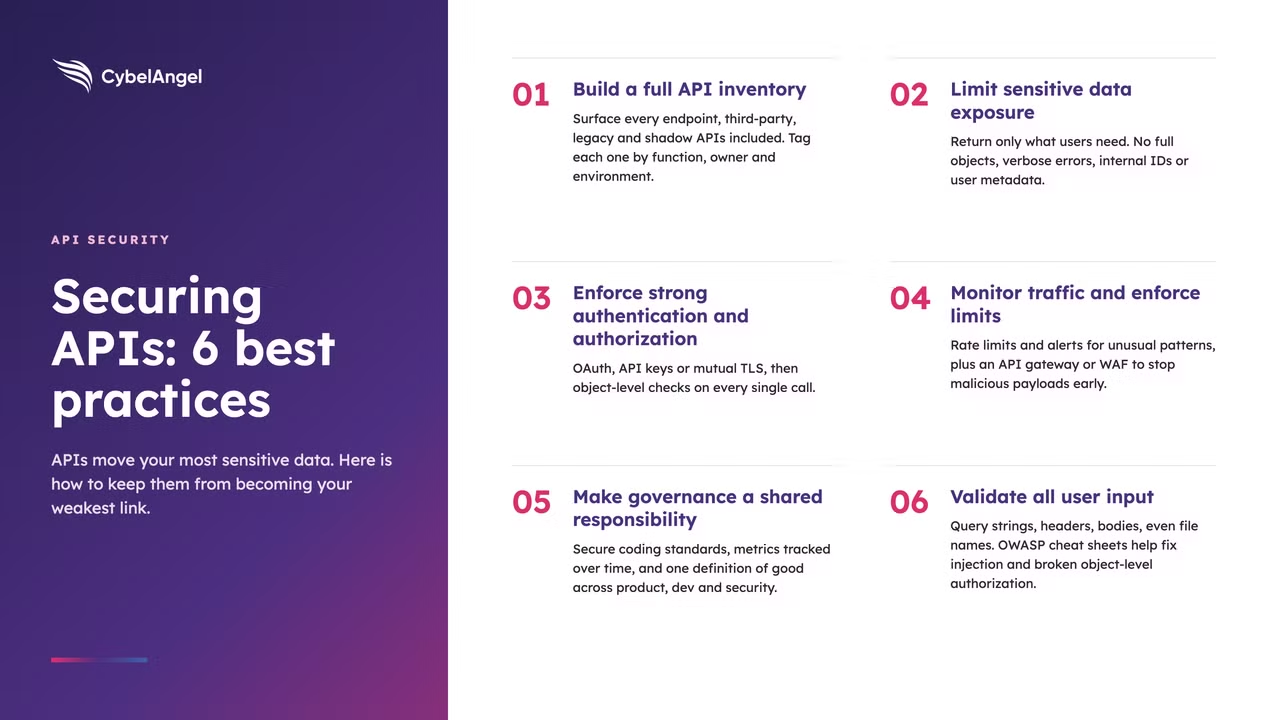
- Build a full API inventory: You can’t protect what you can’t see. Use automated API discovery tools to surface every endpoint, including third-party services, legacy versions, and shadow APIs. Tag them by function, owner, and environment.
- Limit sensitive data exposure: Only return the data a user actually needs. Avoid sending full objects or verbose error messages. Strip internal IDs, user metadata, and anything else that could lead to a data breach.
- Enforce strong authentication and authorization: Apply robust authentication (OAuth, API keys, or mutual TLS). Then go deeper with granular authorization. Every API call should check who’s making the request, and whether they’re allowed to access that object.
- Monitor traffic and enforce limits: Set rate limits and alerts to flag unusual patterns. Use an API gateway or WAF to spot malicious payloads and stop common attacks before they reach the backend.
- Treat governance as a shared responsibility: Security isn’t a checklist. It’s a long-term program. Define secure coding standards, track metrics over time, and make sure product, dev, and security teams all know what “good” looks like.
- Validate all user input: Unfiltered input is one of the most common ways attackers exploit APIs. Validate everything, like query strings, headers, bodies, and even file names. OWASP has excellent cheat sheets to help developers fix issues like injection and broken object-level authorization.
Need help automating the hard parts of your security measures, like discovery, monitoring, and detection?
CybelAngel helps you uncover API risks across your digital ecosystem, including third-party providers you don’t control. Explore CybelAngel’s external threat intelligence solutions to learn more.
Preguntas frecuentes
Because authenticating a user only proves who they are, not what they should be allowed to touch. Over 90% of real-world API attack attempts happen inside valid, authenticated sessions. If your backend doesn’t perform object-level authorization checks on every request, any logged-in user can swap an account ID in a request payload and extract data that belongs to someone else.
Attackers don’t navigate websites like human users, they use automated tools to scan IP blocks, subdomains, and historical DNS records. Forgotten staging endpoints and legacy API versions remain live in the cloud and connected to production databases. Because internal teams forgot they exist, these “hidden” endpoints skip security audits and lack rate limiting, making them prime targets.
AI coding assistants prioritize functional, working code over secure architecture. They frequently generate boilerplate API handlers that lack input validation, omit object-level permission checks, or output overly verbose payloads containing internal database fields. When developers copy-paste this code without review, insecure endpoints end up deployed directly to production at machine speed.
API Gateways operate at the perimeter and inspect incoming requests for valid formatting, API keys, and rate limits. They do not understand your database schemas or application business logic. A gateway cannot tell whether User A is authorized to view Document #8492 or if that document belongs to User B—only your application code or behavioral analysis layer can detect that mismatch.
Wrapping up
APIs power nearly everything we do online. But when mismanaged, they can also create quiet pathways for attackers to slip through.
In 2026, API security risks aren’t necessarily new—they are simply being exploited at higher scale. However, with the right governance, continuous testing, and cheat sheets, they can be kept in check.
CybelAngel helps security teams detect unknown APIs, exposed endpoints, and critical risks before they become data breaches.
Sobre el autor