How to Detect Credential Leaks Before Attackers Exploit Them
Table des matières
Most stolen credentials circulate inside the criminal ecosystem for weeks or months before they are used in an actual intrusion, which gives defenders a meaningful window to find and reset them before any attack begins. Closing that window depends on monitoring the right sources at the right cadence, recognising that the highest-yield sources are rarely the most accessible ones, and treating every infostealer log appearance as urgent regardless of how routine the underlying credential looks. The discipline that separates effective credential monitoring from theatre is not the data feed itself but the operational workflow that gets a flagged credential rotated within hours of detection.
The credential leak lifecycle
When a set of credentials leaks, the chain of events between exposure and exploitation is usually slower than people expect, and understanding the stages of that chain is what makes effective detection possible. Each stage represents both a fresh opportunity for credentials to surface in a new source and a fresh opportunity for defenders to find them before they reach the next stage.
| Stage | Typical duration | What happens | Detection opportunity |
|---|---|---|---|
| 1. Initial harvest | Heures en jours | Infostealer infects an employee or contractor device and exfiltrates browser-saved credentials, cookies, and autofill data to an attacker-controlled server | Endpoint detection of the infostealer itself; difficult once exfiltration has completed |
| 2. Log packaging | Days to weeks | Stealer operator packages the raw logs into sellable bundles, often categorised by country, target industry, or domain quality | Threat intelligence on stealer operator behaviour; limited at this stage |
| 3. Marketplace listing | Days to weeks | Bundles appear on infostealer log marketplaces, typically priced at $5 to $50 per log depending on freshness and target value | High-yield monitoring opportunity; credentials are now visible to anyone with access |
| 4. Resale and recombination | Weeks to months | Credentials filter into combolists, get cross-posted to Telegram channels, and are absorbed into broader breach aggregations | Continued monitoring opportunity; freshness decreases but coverage broadens |
| 5. Initial access broker pickup | Weeks to months | An IAB acquires the credentials, validates them against the target, and packages them with reconnaissance for sale to ransomware affiliates or other end users | Detection still possible but window narrowing rapidly |
| 6. Exploitation | Hours to days once acquired | End user attempts login, lateral movement, or sale of validated access | Detection window closed; response is now incident response, not prevention |
The teams that close credential exposure successfully are the ones operating in stages 3 and 4. By stage 5 the credential has been validated and the attacker has invested in the operation, which means rotation will detect but not prevent. By stage 6 the credential is already in use and the conversation has shifted from monitoring to incident response.
Where credentials actually surface
The sources that produce credential leak signal differ significantly in coverage, freshness, and the volume of work required to extract value from them. A defender who only monitors public breach corpora is missing the majority of fresh material, while a defender who only monitors one infostealer marketplace is missing the credentials that have already passed through resale.
| Source category | Examples | Typical freshness | Coverage | Access difficulty |
|---|---|---|---|---|
| Infostealer log marketplaces | Russian Market, 2easy, post-Genesis successors | Hours to weeks | Limited per marketplace but high quality | High; requires careful operational security and reputation |
| Telegram log channels | Rotating channels distributing RedLine, Lumma, Vidar, Raccoon, StealC logs | Hours to days for free samples; longer for paid feeds | Broad but variable quality | Moderate; channels rotate frequently and require active discovery |
| Criminal forum breach sections | XSS, Exploit, BreachForums and its successors | Days to months | Broad, including older breaches | High; requires forum access and credibility |
| Combolist aggregations | Various forum and Telegram-based aggregators | Days to months | Very broad but high noise | Moderate; mostly recycled material |
| Paste sites and code repositories | Pastebin, GitHub gists, GitLab snippets, anonymous file hosts | Minutes to hours | Narrow but occasionally critical, especially for service accounts and API keys | Low; publicly accessible |
| Public breach corpora | Have I Been Pwned, DeHashed | Weeks to months | Broad but lagging | Low; documented APIs |
| Customer-reported exposures | Internal reporting, partner notifications | Variable | Narrow; only what gets reported | Low |
Infostealer log marketplaces and Telegram log channels are the two highest-yield sources, and they are also the two that produce the most operationally relevant credentials for an enterprise defender. The credentials arrive freshly stolen rather than aggregated from old breaches, which makes them both more dangerous to leave unaddressed and more useful as a defensive early warning. Public breach corpora remain a useful baseline but should not be confused with comprehensive coverage, since they typically lag the criminal ecosystem by months and cover only the credentials that someone has chosen to make public.
How long the detection window really is
The detection window varies significantly by stealer family, by the operator behind the log, and by how the credentials are eventually used, but a few reasonably reliable patterns hold across most documented cases.
| Stealer family | Typical time from infection to first marketplace appearance | Typical time from marketplace appearance to first exploitation | Effective detection window |
|---|---|---|---|
| RougeSuie | 1 to 7 days | 2 to 6 weeks | 2 to 6 weeks |
| Lumma | 1 to 5 days | 1 to 4 weeks | 1 to 4 weeks |
| Vidar | 2 to 10 days | 2 to 8 weeks | 2 to 8 weeks |
| Raton laveur | 1 to 7 days | 2 to 6 weeks | 2 to 6 weeks |
| StealC | 1 to 5 days | 1 to 3 weeks | 1 to 3 weeks |
| AZORult and other legacy families | Days to weeks | Often months or never | Variable |
The figures above are approximate and depend heavily on the operator and on whether the credentials are being aggressively monetised or held for higher-value targeting. What matters operationally is that the detection window is rarely less than a week and is frequently several weeks, which means a security team that finds an exposed credential within the first week of marketplace appearance has a high probability of preventing the intended intrusion entirely.
What credentials are worth monitoring for
Not every credential category carries the same risk, and a monitoring programme that treats all credentials equally will produce more alert fatigue than security value. Prioritisation matters.
| Credential category | Risk level | Pourquoi c'est important | Monitoring priority |
|---|---|---|---|
| Privileged user accounts (domain admin, root, cloud admin) | Critical | Direct path to widespread compromise; single credential can enable enterprise-wide intrusion | Immediate; treat any appearance as an active incident |
| VIP and executive accounts | Critical | High social engineering value; access to financial and strategic systems | Immediate; coordinate with executive security if applicable |
| Service accounts and API keys | Haut | Often have broad permissions, are rotated less frequently, and may be embedded in infrastructure code | High; rotation is operationally harder so detection is more valuable |
| VPN and remote access credentials | Haut | Direct path to network access; commonly targeted by ransomware affiliates | High; rotate immediately on detection |
| Standard employee credentials | Moyen | Foothold for lateral movement and phishing; less immediately damaging | Standard; rotate within 24 hours |
| Customer credentials on your platforms | Moyen | Reputational and regulatory exposure; risk to individual users | Standard; communicate with affected users per your incident response policy |
| Test, sandbox, and decommissioned account credentials | Low | Limited operational value but may indicate broader exposure pattern | Investigate the broader exposure rather than rotating the individual credential |
Detection signal quality by source
Different sources produce different qualities of detection signal, and an effective monitoring programme calibrates expectations accordingly rather than treating every alert as equally actionable.
| Source | Signal strength | False positive rate | Investigation depth required |
|---|---|---|---|
| Fresh infostealer marketplace logs matching your domain | Very strong | Low | Validate, rotate, hunt for the infected endpoint |
| Telegram log channel previews | Strong | Low to moderate | Validate freshness, then escalate to full investigation |
| Combolist appearance with verified freshness | Moderate | Moderate; many credentials are recycled | Verify the credential is currently valid before urgent rotation |
| Public breach corpora match | Weak to moderate | High; often months out of date | Treat as a baseline hygiene signal rather than urgent |
| Paste site or repository exposure | Strong if recent | Low | Validate the exposure scope and rotate immediately |
| Customer or partner notification | Strong | Low | Investigate as a confirmed incident |
The operational discipline most teams miss
Effective credential leak detection is not a single tool but a discipline that combines three things working together, and the third is the one that most monitoring programmes underinvest in.
Continuous monitoring across the sources above, calibrated to your specific email domains, your common username patterns, any service-account naming conventions you use, and the brand variations attackers might use to phish your employees. This is the part most teams get right at the procurement stage.
Rapid triage when matches surface, since the value of detection collapses if a hit sits in a queue for a week. The right metric here is time from monitoring alert to validated decision, and teams that measure this honestly typically discover their median is much longer than they thought.
A forced password reset workflow that can move a flagged credential through validation and rotation in hours rather than days, including service accounts and shared credentials that organisations typically rotate far less aggressively than user passwords. This is the part most teams underinvest in, and it is the part that determines whether credential monitoring actually prevents intrusions or just documents them. The teams that get the most value from credential leak monitoring are the ones that have closed the loop end to end, from detection through to verified rotation, with no manual steps that depend on a single overworked analyst remembering to follow up.
How CybelAngel helps
CybelAngel's Credential Intelligence module continuously monitors infostealer marketplaces, criminal forums, Telegram channels, and paste sites for credentials tied to your domains, your subsidiaries, and your VIP and executive accounts. The intelligence flow is tuned to surface fresh stealer-log material rather than recycled breach data, which means your security team sees the credentials that matter and not the noise from old aggregations.
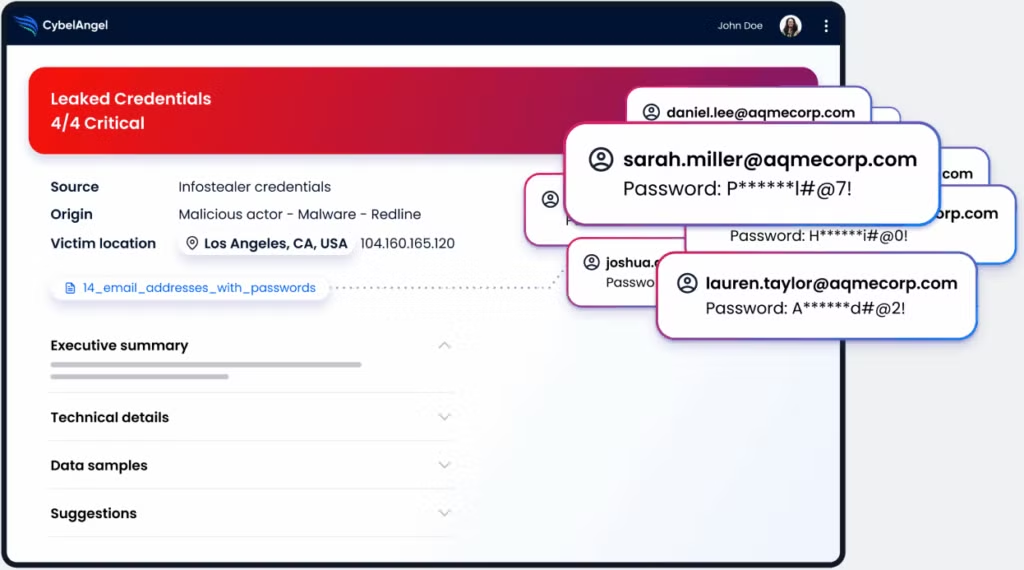
For organisations facing active credential exposure or a suspected widespread compromise, our REACT team provides accelerated investigation, infected endpoint identification, and rotation support to close the detection window before it becomes an incident.
À propos de l'auteur