The Dark Web Telegram Channels Attackers Are Actually Using in 2026
Inhaltsübersicht
In unserem explainer on why threat actors moved part of their business to Telegram, we covered the structural story: what changed in 2024, why it created an intelligence gap for security teams, and what’s moved to these channels in general (stolen credentials, compromised session tokens, malware configuration files). It’s worth a read if you’re just catching up on why a messaging app is part of the dark web story at all.
This piece is the next level down, because the trend has only accelerated: which specific channels are most active right now, what’s circulating inside them, and what you actually need to be watching for if you’re one of the security teams that just added Telegram monitoring to your 2026 priority list.
The names to know
If you’re only going to watch a handful of channels, these are the ones that consistently place at the top of the activity reports we see:
- Chthonic: The single most active credential-sharing channel in our latest tracking window. If a corporate password is going to show up in a Telegram group, it’s most likely here.
- Eternity: Less volume than Chthonic, but a higher concentration of compromised session tokens, API keys, and service accounts — the access that bypasses MFA on use.
- EternityAIO: Eternity’s dedicated channel for all-in-one (AIO) malware tools, separate from the credential feeds. A regular source of fresh Raccoon and Vidar stealer samples.
- Xtreme: Was the go-to place for buying compromised remote-access tools (TeamViewer, ConnectWise, Citrix). Now overtaken by Chthonic for raw volume but still active.
- CC Lounge: The main hub for stolen payment cards, still the first place most compromised card data moves through.
- Club2crd: The second-largest carding channel after CC Lounge.
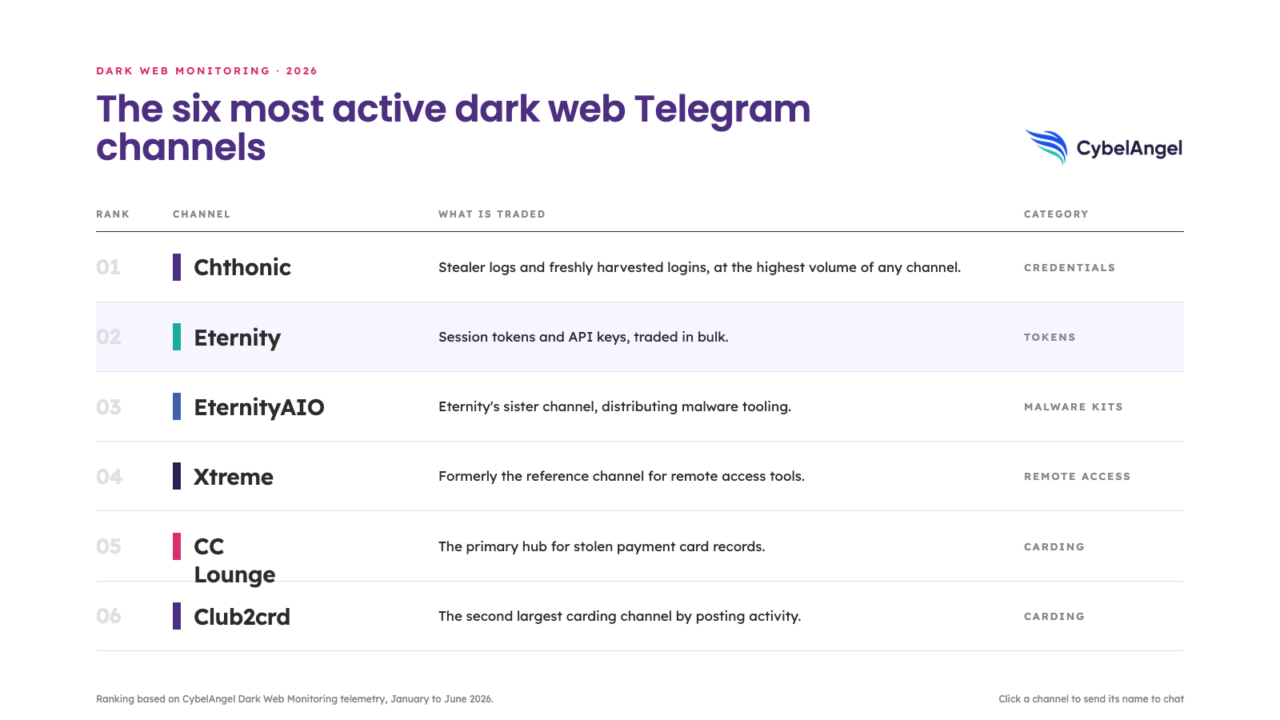
One note that’s simple but important: these aren’t hacker handles. They’re the actual channel names. If you’re searching for your own brand exposure in Telegram, these are the literal strings to start with.
The pattern behind every takedown
What’s most visible in our trend data is a pattern you can almost set your watch by: every time a major channel gets taken down, activity craters for a few days, then a new one pops up and vacuums up the displaced user base. The names at the top of the list shift, but the list itself doesn’t shrink.
It’s the same dynamic we covered in our breakdown of the breach forum landscape after the BreachForums takedown: operators and infrastructure get disrupted, but the community reconstitutes itself incredibly quickly, because what’s really happening is less a few isolated groups collaborating and more an organic network of individual relationships regrouping around whatever the current top meeting spot is. Taking out today’s busiest channel is a win, but it’s a time-bound one. The gap it creates is an opening, not an ending.
Why this is your problem even if you’re not in these channels
None of these are places an enterprise security team would naturally hang out. Your brand getting mentioned in one of them might trigger an alert if you’re doing basic dark web monitoring, but that’s not really the main risk. The main risk is your own exposed credentials moving through them while you’re not watching.
This is the key thing to understand about how Telegram fits into the actual intrusion chain. A generic brand hit, someone invoking your company name in a sketchy place, that’s not nothing, but it’s also not an IOC on its own. Your leaked VPN password getting passed around, that’s materially different. One is a vague signal that someone might be interested in you. The other is the specific key an attacker will actually use to get in, and they’re going to use it whether you saw it happen or not.
How this monitoring is different from just watching for brand hits
A garden-variety dark web monitoring setup, the kind that just scans paste sites and forum posts for keywords, doesn’t cover what’s circulating in these closed channels. It catches your company name showing up somewhere public. It doesn’t put you in the room where an attacker is showing off the keys to your front door.
Watching that second conversation is partly a sourcing problem — you need direct access to the channels themselves, not just a broad crawler — but it’s mostly an analysis problem. You’re not just looking for a word match (“Acme Inc”). You’re pattern-matching for exposed access:
- Email/password pairs with your domain
- Session tokens for your corporate SSO
- API keys to your third-party services
- Private keys to your code repos
- Active cookies for your cloud consoles
And if you catch one, “monitor harder” isn’t the real prescription. Rotating the exposed access immediately, before it moves from “leaked” to “used,” is.
The right way to act on an exposure
One mistake security teams make when they catch a credential exposure is thinking they have time. If it’s just sitting in a paste site or tucked in a forum thread, sure, you might get away with watching it for a day or two before you force a reset on your side. If it’s circulating in one of these Telegram channels, you don’t have that luxury.
This is an active market, not a historical archive. Leaks get scraped, repackaged, and resold here incredibly fast, specifically because buyers are using what they purchase. Hours matter. The difference between shutting down a leaked password before it gets used versus after is the difference between a credential reset and an incident response.
FAQs
Chthonic and Eternity consistently place at the top of the activity rankings. Chthonic is the single largest source of compromised corporate credentials; Eternity is smaller by volume but has a higher concentration of session tokens, API keys, and service accounts that bypass MFA when used.
Hours, not days. These are active marketplaces, not historical archives. Stolen access gets repackaged and resold fast specifically because buyers are using what they purchase. The window to reset an exposed password before it becomes an incident is short.
Depth, mostly. A standard dark web monitoring setup scans for brand hits, your company name showing up somewhere it shouldn’t. Dedicated Telegram monitoring looks for exposed employee credentials circulating inside closed channels, not just for public mentions. It’s a more direct intrusion signal.
Reset it immediately. Don’t wait for signs of abuse. The difference between rotating a leaked password before it gets used versus after is the difference between a basic access reset and a full incident response.
Über den Autor