The Gentlemen Ransomware: Attack Methods and 2026 Status
Table of contents
The Gentlemen ransomware group went from an unknown name in mid-2025 to the most prevalent ransomware operation in the world by October 2026, when Check Point Research found it responsible for 13% of all published attacks, just ahead of Qilin at 12%, the group its founder used to work for. More than 1,100 organisations have now been named on its leak site, and on November 18, 2026 the list grew to include NVIDIA, which says it has found no sign that its own systems were affected and is investigating an incident at a third-party partner while a countdown on the leak site runs towards November 28.
This guide covers who The Gentlemen are, how the ransomware-as-a-service operation works from initial access to data leak, which attacks have been confirmed so far, what is and is not known about the NVIDIA claim, and which indicators security teams can use to detect an intrusion before encryption begins.
What is The Gentlemen ransomware?
The Gentlemen is a ransomware-as-a-service (RaaS) operation that steals data before encrypting systems and then threatens to publish what it has taken, a model usually described as double extortion. Microsoft tracks the operators as Storm-2697, Sophos calls them GOLD SHERWOOD, and MITRE added the group to its ATT&CK knowledge base as G1058 in September 2026, which is a reasonable sign of how quickly it has become a fixture of the threat landscape.
The operation grew out of a dispute inside another ransomware programme. According to Group-IB’s analysis, the founder, a Russian-speaking actor known as hastalamuerte, previously ran a Qilin affiliate crew called ArmCorp, and on July 22, 2025 he opened a public arbitration thread on the RAMP forum claiming that Qilin owed him $48,000 in unpaid ransom share. The first Gentlemen sample had already been uploaded to VirusTotal five days earlier with the address of a leak site built in, which suggests that the complaint was less a grievance than a public exit from a programme he had already decided to compete with.
What sets the group apart is how small and how centralised it is. Internal chats that leaked in May 2026 showed roughly nine named accounts gathered around a single administrator known as zeta88, whom Check Point considers very likely to be the same person as hastalamuerte and who builds the locker, runs the affiliate panel, hands out targets and manages payouts. Affiliates keep 90% of every ransom, which is more generous than the 70% to 80% that most competing programmes offer, and Check Point believes that the difference is drawing experienced operators away from older brands.
Timeline of The Gentlemen ransomware attacks
The Gentlemen ransomware group has listed victims in more than 90 countries across manufacturing, technology, healthcare, education, energy and government, although only a small share of those listings have been confirmed by the organisations concerned, which is why the timeline below separates what victims have said from what the group has claimed.
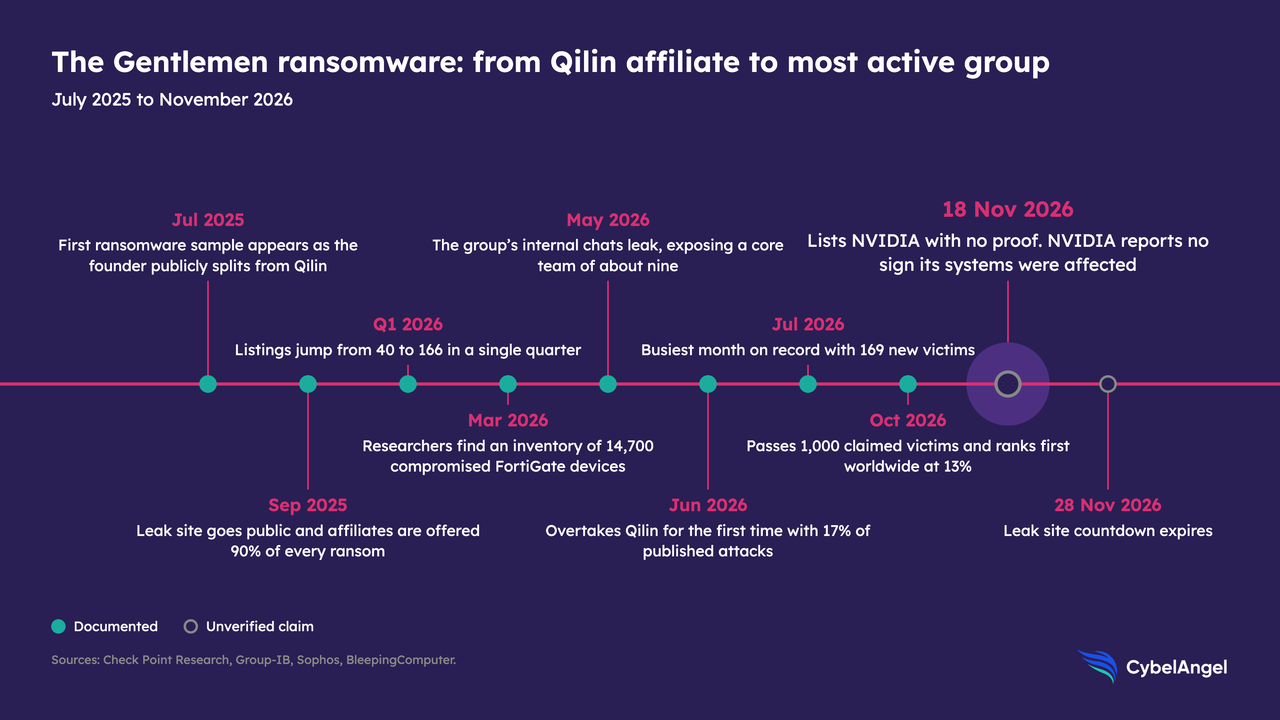
- July 2025: The first Windows sample of The Gentlemen ransomware is uploaded to VirusTotal on July 17, and five days later hastalamuerte files his arbitration claim against Qilin on the RAMP forum over 14 targets he says he worked on as an affiliate.
- August 2025: Trend Micro investigates the first documented campaign and finds an internet-facing FortiGate appliance with a compromised administrator account, Group Policy abuse for domain-wide deployment, and anti-antivirus tools that were rewritten during the intrusion to target the specific security product the victim was running.
- September 2025: The leak site becomes publicly known, the group advertises its affiliate programme on RAMP with a 90/10 revenue split, and a dedicated ESXi locker is released on September 10, which extends the operation from Windows servers to the virtualisation layer.
- January to March 2026: Listings rise from 40 in the last quarter of 2025 to 166 in the first quarter of 2026, which Check Point describes as the breakout story of the quarter. Only 13% of those victims are in the United States, against an average of 49.6% for the ecosystem as a whole, and Thailand alone accounts for more than a tenth of them.
- February 2026: Hospital Caribbean Medical Center in Puerto Rico confirms an attack affecting around 92,000 people, one of eight healthcare incidents that Comparitech had verified by the summer and an early sign that the group does not observe the informal rule some ransomware crews follow of leaving hospitals alone.
- March 2026: Group-IB publishes evidence that the operators hold an inventory of about 14,700 compromised FortiGate devices and 969 validated VPN credentials obtained by brute force, which they share with affiliates as a ready-made list of ways in.
- April 2026: During an incident response engagement, Check Point Research gains access to a live command-and-control server belonging to an affiliate and finds more than 1,570 likely corporate victims that had been quietly compromised and were waiting for further action, a figure far higher than the 320 organisations the group had named publicly at the time.
- May 2026: On May 4 the administrator acknowledges on underground forums that the group’s internal Rocket.Chat database has leaked. The published sample covers 22 chat rooms and 3,733 messages written between November 2025 and April 2026, including negotiation transcripts in which an opening demand of around $250,000 settles at $190,000. On May 6 the group lists Turkish appliance maker Arçelik, which says the following day that an internal service management platform was breached through a subcontractor in an incident detected on April 28. Later that month Microsoft documents a self-propagating encryptor that tries eight lateral movement techniques against every host it can reach.
- June 2026: The Gentlemen overtakes Qilin for the first time with 17% of published attacks against Qilin’s 11%. On June 28 the group lists Thyssenkrupp Marine Systems and Atlas Elektronik with a claim of more than 1TB of stolen data, and TKMS confirms an intrusion that it says was confined to a segmented North American subsidiary and did not expose sensitive military information. Denmark’s National Museum, Croatia’s Ministry of Health and a subsidiary of Spain’s Indra Group are also among the confirmed victims that month.
- July 2026: The leak site records its busiest month to date with 169 new victims and a running total of 683. Colombia’s state oil company Ecopetrol tells Reuters that data tied to roughly 3,300 user accounts was stolen, and South Carolina health system AnMed confirms an incident.
- August to September 2026: Upper Austria’s Chamber of Labour is attacked on August 10 and its Salzburg counterpart warns that the data of around 270,000 members may have been accessed, eleven days before the group lists the organisation. Nutex Health reports a cyberattack to the US Securities and Exchange Commission on August 24 and The Gentlemen claims it on August 31, and Veradigm files a disclosure on September 8, four days after being listed, in which it traces the incident to credentials stolen from a third-party vendor. Neither company has named its attacker.
- Third quarter of 2026: GuidePoint’s quarterly report names The Gentlemen as the most active ransomware group of the third quarter, although only by a fraction, with both it and Qilin holding about 13% of all recorded victims.
- October 2026: The leak site passes 1,000 claimed victims on October 19, with 135 added in the previous 30 days. The group also lists two companies in NVIDIA’s orbit, Taiwanese thermal component supplier Jentech Precision Industrial on October 6 with a claim of more than 9TB of data, and FPT Software on October 27, neither of which has confirmed an incident.
- November 2026: NVIDIA appears on the leak site on November 18 with a countdown that expires on November 28. The listing contains no samples, no file list and no stated data volume.
One counterpoint is worth keeping in mind when reading these numbers, which is that a leak site listing is a claim made by criminals and not evidence of a breach. Ransomnews has verified 95 attacks by the group through victim statements and regulatory filings, which works out at roughly one confirmed incident for every twelve listings, and the gap between the two figures is a useful reminder to treat any individual claim with caution until the named organisation or a regulator has spoken.
Did The Gentlemen ransomware group breach NVIDIA?
At the time of writing, on November 25, 2026, there is no public evidence of an NVIDIA data breach, and the company has said in terms that it has found no indication that its systems or networks were affected. What NVIDIA has confirmed is narrower, namely that it is looking into an incident that may have affected a third-party partner, and it has not named that partner or described what data, if any, was involved.
The context makes a supplier explanation plausible without proving it. The Gentlemen had already listed Jentech Precision Industrial and FPT Software in October, both of which work with NVIDIA, and the NVIDIA entry was posted less than 12 hours after the company’s third-quarter results call, which is the kind of timing a ransomware group chooses when it wants attention more than it wants to demonstrate access. A Cybernews researcher quoted in the same reporting suggested that the claim is most likely either misattributed data or a small breach of limited consequence.
For security teams the practical lesson does not depend on how the countdown ends, because an NVIDIA ransomware claim built on a partner’s data would be one more example of a pattern in which the name on the leak site belongs to the largest company in a supply chain while the intrusion happened at one of the smallest. We will update this section after November 28.
Who does The Gentlemen ransomware target?
The Gentlemen ransomware group chooses victims opportunistically and has no declared sector restrictions. Manufacturing is the most frequently hit industry in every major tracker, followed by technology and professional services, and healthcare ranks third in Check Point’s data, which is unusual for a programme of this size. Kaspersky’s telemetry adds financial services, construction and logistics to the list.
The geography has shifted over time in a way that matters for European and North American organisations. In its first months the group was concentrated in Asia-Pacific and Latin America, with Thailand, Brazil, Indonesia and Taiwan prominent in Check Point and Kaspersky data, whereas since the May 2026 leak the United States and Canada together account for about 29% of listings and France, Germany, Italy and India each appear between 22 and 27 times, according to Ransomnews.
Leaked chats show that affiliates are steered towards targets by revenue, likelihood of payment, regulatory exposure and how easy the network is to enter, and Group-IB notes a stated preference for firewalls that are integrated with LDAP and serve a large number of users. Compromised organisations tend to share the same weak points:
- Internet-facing FortiGate, Cisco and other VPN or firewall appliances that are unpatched or that expose their management interface
- VPN, Outlook Web Access and Microsoft 365 accounts without multi-factor authentication, whose passwords have been brute forced, bought from an access broker or harvested from infostealer logs
- A flat Active Directory domain in which a single domain administrator account can push software to every machine through Group Policy
- Backup and virtualisation infrastructure, particularly Veeam servers and ESXi hosts, that can be reached with domain credentials
How does The Gentlemen ransomware work?
Gentlemen affiliates gain access through exposed edge devices and valid credentials, disable endpoint protection with vulnerable drivers, steal data with ordinary file transfer tools and then deploy the encryptor across the whole domain at once. The main locker is written in Go and heavily obfuscated, it runs on Windows, Linux, NAS, BSD and VMware ESXi, and it encrypts files with a combination of Curve25519 and XChaCha20. Sophos analysed 15 intrusions and found that the median time from the first sign of activity to ransomware deployment was about two days, with the fastest case taking less than 24 hours.
The Gentlemen ransomware IOCs
- Fortinet authentication bypass:
CVE-2024-55591in FortiOS and FortiProxy is the vulnerability named most often in the group’s own chats, where FortiGate appears dozens of times, and S2W describes affiliates using it to obtain super-admin rights on the firewall, create backdoor accounts and keep access through SSL VPN. - Other vulnerabilities tracked by the operators:
CVE-2025-32433(Erlang/OTP SSH remote code execution),CVE-2025-33073(Windows SMB client NTLM reflection),CVE-2024-37085(VMware ESXi authentication bypass through Active Directory group membership) andCVE-2023-27532(Veeam Backup & Replication credential exposure) are all discussed or shared in the leaked material, although Check Point notes that the chats do not prove each one was exploited successfully. - Ransom note and file extensions: The Go locker drops
README-GENTLEMEN.txtin every affected directory and appends a six-character extension that changes from one victim to the next, with.7mtzhhand.fjn1jwamong those observed. A newer C-based variant that Kaspersky found still in development uses a differently named note and replaces Tox with email for negotiation. - Locker file names: Samples follow patterns such as
locker_<ext>_windows_amd64.exeandG_<ext>_windows_amd64.exe, and have also been seen aswin.exe,gentle.exeanddecryptor.exeplaced on the NETLOGON share. Every build requires a--passwordargument before it will run, which defeats most automated sandboxes. - EDR killers and vulnerable drivers: ESET has identified eight variants of an in-house framework it calls GentleKiller, which abuses drivers including
dmx.sys,nseckrnl.sys,GameDriverX64.sysand360netmon_wfp.sys, alongside the third-party tools HexKiller (googleApiUtil64.sys), ThrottleBlood (ThrottleBlood.sys) and HavocKiller (havoc.sys). The binaries are usually named after security vendors or anti-cheat products. - Kontron driver zero-day: In an intrusion investigated by Expel, the attackers used a previously undocumented flaw in
ktapi.systhrough a payload namedwas.exeto terminate Microsoft Defender, ESET, Cortex XDR and SentinelOne processes, and the driver was not on any public blocklist at the time. - Staging directories: Tools are commonly placed in
C:\PerfLogs, in a folder namedGentlemenCollection, and in the NETLOGON and SYSVOL shares of a domain controller. - Persistence artefacts: A scheduled task named
UpdateUser, a Run key value namedGupdateS, and a task namedWindowsConnSvcthat launchesC:\Windows\Temp\svchost32.exeevery two minutes as a SOCKS proxy have all been documented. - Command and control (C2) servers: Kaspersky observed a Go backdoor named
sihost.execommunicating with81.177.215[.]15:9443about a day before encryption, and Huntress recorded proxy connections to193.233.202[.]17and77.110.122[.]137. - Exfiltration tooling: Rclone is the preferred tool and is sometimes renamed
avastrclone.exe, with Restic, the MinIO client writing to Wasabi storage, MEGAsync, FileZilla and WinSCP also observed. - Remote access tools: AnyDesk, Datto RMM and Cloudflared installed as a Windows service with a valid tunnel token have been used to keep a route back into the network.
The Gentlemen ransomware TTPs
Initial access
T1190Exploit Public-Facing ApplicationT1078Valid AccountsT1110Brute ForceT1133External Remote Services
Phishing does not feature in the published incident analyses or in the leaked chats, and the group’s pipeline is built instead on scanning for exposed FortiGate and Cisco appliances, brute forcing VPN logins and buying access from brokers. In one incident examined by Sophos, the attacker simply logged in to a Fortinet SSL VPN with stolen credentials from an IP address in the Netherlands, on an account that had no multi-factor authentication, and opened several further sessions from other countries within the hour.
Execution and persistence
T1059.001PowerShellT1053.005Scheduled TaskT1547.001Registry Run Keys / Startup FolderT1543.003Windows Service
Once inside, affiliates enable PowerShell remoting, create scheduled tasks that re-run their tools if they are stopped, and switch on Remote Desktop where it was disabled by changing the registry and adding a firewall rule for port 3389.
Privilege escalation and defence evasion
T1068Exploitation for Privilege EscalationT1562.001Impair Defenses: Disable or Modify ToolsT1070.001Clear Windows Event LogsT1036Masquerading
This is the stage at which The Gentlemen differs most from its competitors, because the operators maintain the EDR killers themselves and hand them to affiliates as a ready-made kit, whereas most ransomware programmes leave each affiliate to find their own. GentleKiller targets more than 400 processes belonging to 48 security products, and ESET found that newly published proof-of-concept exploits for vulnerable drivers were being adopted within days of release. Affiliates also add the whole of the C: drive to the Microsoft Defender exclusion list, turn off real-time monitoring and Controlled Folder Access, and clear the System, Application and Security event logs.
Credential access and discovery
T1003.001OS Credential Dumping: LSASS MemoryT1555.003Credentials from Web BrowsersT1557.001LLMNR/NBT-NS Poisoning and SMB RelayT1046Network Service Discovery
Attackers map the network with Advanced IP Scanner, SoftPerfect Network Scanner and Nmap, enumerate Active Directory with SharpADWS and NetExec, dump LSASS memory, relay NTLM authentication and extract saved passwords from Chrome, and Kaspersky has also seen them capture network traffic with the built-in netsh trace command so that credentials can be pulled out of it later in Wireshark.
Lateral movement
T1021.001Remote Desktop ProtocolT1021.002SMB/Windows Admin SharesT1484.001Group Policy Modification
With domain administrator rights in hand, the group moves through RDP, PsExec, WMI and WinRM, and then uses Group Policy as its delivery mechanism. Kaspersky documented a script named deploy_gpo.ps1 that copies the locker to NETLOGON and SYSVOL, registers a scheduled task through a policy object and runs gpupdate /force, so that every domain-joined machine starts encrypting at the same moment. The encryptor also has a built-in --spread option which, according to Microsoft, attempts a series of remote execution methods against each host it can reach.
Exfiltration and impact
T1567.002Exfiltration to Cloud StorageT1486Data Encrypted for ImpactT1490Inhibit System RecoveryT1489Service Stop
Data leaves the network before the payload runs, and in one case Sophos saw Rclone in use about 25 minutes after the first activity on the network. Before encryption the locker stops Hyper-V virtual machines, kills database, backup and office processes, disables Veeam, SQL and Backup Exec services, and deletes shadow copies, while a separate PowerCLI script has been used against vCenter to disable high availability and power off virtual machines ahead of the ESXi locker. Speed modes that encrypt as little as 1% of each file allow an entire estate to be locked within hours.
How to prevent The Gentlemen ransomware attacks
Protecting an organisation against The Gentlemen means building defences around how the group actually gets in and what it does next, which is edge devices and credentials first and the removal of endpoint protection second, and not around the detection of the ransomware binary itself.
- Patch and lock down edge devices first. Apply the fixes for CVE-2024-55591 and the other vulnerabilities listed above, remove firewall and VPN management interfaces from the public internet, and review FortiGate configurations for administrator accounts that nobody recognises, because a device that was compromised before it was patched remains compromised afterwards.
- Assume that credentials are already exposed. Enforce multi-factor authentication on every VPN, OWA and Microsoft 365 account, including service accounts, and monitor for corporate credentials appearing in infostealer logs and breach dumps so that they can be reset before somebody tests them against a gateway.
- Control which drivers can load. Expel considers Windows Defender Application Control with a driver allowlist to be the strongest protection against vulnerable-driver attacks, and recommends enabling memory integrity and alerting on new driver services, because the Microsoft blocklist is updated too slowly to keep pace with a group that adopts new drivers within days.
- Treat tampering as an incident. A Defender exclusion for the whole C: drive, a security product that stops reporting or a cleared Security event log should each be escalated on its own, since they tend to appear hours before encryption.
- Watch Group Policy and NETLOGON. Alert on new executables or scripts in NETLOGON and SYSVOL, on new policy objects that create scheduled tasks, and on forced policy refreshes outside change windows.
- Detect exfiltration, not only encryption. Rclone, Restic, the MinIO client and MEGAsync have few legitimate uses on a file server, and large outbound transfers to cloud storage providers are the part of the attack that makes the extortion possible.
- Alert on unexpected remote access tools. AnyDesk, Datto RMM and Cloudflared tunnels that appear outside sanctioned use are worth investigating immediately.
- Keep immutable, offline backups. Copies should not be reachable with domain accounts, and restoration should be tested, because the group deliberately disables backup services and removes snapshots before it encrypts.
- Segment the network. Separating domain controllers, backup servers and hypervisors from user networks limits how far a single set of stolen credentials can travel.
- Extend monitoring to suppliers. The NVIDIA episode shows that a company can end up on a leak site because of data held by a partner, which makes visibility of third-party exposure as important as visibility of your own.
The Gentlemen ransomware mitigation
The Gentlemen depends on exposure that is visible from outside the network before any intrusion takes place, which means that much of the work of mitigation can be done in advance.
Mitigate double extortion ransomware:
- Protect your attack surface. CybelAngel’s Attack Surface Management solution continuously scans the internet, including shadow IT and third-party assets, to identify exposed VPN gateways, firewall management interfaces and unpatched services, which are the entry points that Gentlemen affiliates look for.
- Credential leak monitoring. Stolen and brute-forced credentials sit at the centre of the group’s access pipeline. CybelAngel’s Credential Intelligence alerts you when corporate logins are harvested by infostealers or dumped online, so that they can be reset before an affiliate tries them.
- Data leak detection. The Gentlemen uses double extortion to pressure victims and their partners. CybelAngel’s Data Breach Prevention monitors dark web forums, marketplaces and leak sites, including listings that name your suppliers, which enables faster incident response.
- Real-time alerts and remediation. Secure assets and sensitive information with CybelAngel’s Remediation solution, especially when company information has already appeared on the dark web.
FAQs
The Gentlemen is a ransomware-as-a-service operation that emerged in mid-2025 and is run by a Russian-speaking administrator known as hastalamuerte or zeta88, who previously worked as a Qilin affiliate under the name ArmCorp. Microsoft tracks the group as Storm-2697 and Sophos as GOLD SHERWOOD. Leaked internal chats point to a core team of about nine people, with attacks carried out by affiliates who keep 90% of each ransom.
Yes, The Gentlemen was the most prevalent ransomware group in October 2026 with 13% of published attacks, and it has listed more than 1,100 victims on its leak site since September 2025. A leak of its internal chats in May 2026 did not slow it down, and weekly listings rose from about 19 before the leak to about 27 afterwards.
That has not been confirmed, because although the group added NVIDIA to its leak site on November 18, 2026 with a countdown ending on November 28, it published no samples or file lists. NVIDIA says it has found no indication that its systems or networks were affected and that it is investigating an incident that may have affected a third-party partner.
The founder of The Gentlemen was a Qilin affiliate until July 2025, when he publicly accused Qilin of withholding $48,000 in ransom share and left to launch his own programme. Researchers have found that the group studied Qilin, LockBit 5.0, Babuk and Medusa samples to improve its own locker. The two groups have traded first place in monthly rankings throughout 2026.
Most often through internet-facing firewalls and VPN gateways, and through valid credentials. Affiliates exploit the FortiOS authentication bypass CVE-2024-55591, brute force VPN, OWA and Microsoft 365 logins, and buy access from brokers. Researchers found an inventory of about 14,700 compromised FortiGate devices that the operators share with affiliates. Phishing does not feature in the published incident analyses or the leaked chats.
GentleKiller is the name ESET gave to the EDR-killing framework that The Gentlemen operators build and supply to their affiliates. At least eight variants exist, each abusing a different vulnerable or malicious driver to gain kernel access and terminate security software. It targets more than 400 processes across 48 security products and is used alongside the third-party tools HexKiller, ThrottleBlood and HavocKiller.
The most reliable indicators are a ransom note named README-GENTLEMEN.txt, encrypted files with a random six-character extension, locker binaries on the NETLOGON share, new Microsoft Defender exclusions covering the whole C: drive, unfamiliar driver services, cleared event logs, and tools such as Rclone or Restic staged in C:\PerfLogs. Several of these appear before encryption starts.
About the author