Attack Surface Management Tools: How to Evaluate Them in 2026 (Buyer’s Checklist)
Table of contents
A forgotten subdomain still resolving to a decommissioned server. A partner’s VPN appliance running three patches behind. A GraphQL endpoint an engineering team stood up for a pilot and never took down. None of these appear on your asset inventory, which is exactly why they’re worth an attacker’s time. In July 2026, a French exam-results platform exposed roughly 730,000 Bac candidates’ results because it switched on an API a few hours ahead of schedule, not because anyone attacked it. Nobody was watching that access point. That’s the exposure category this guide covers: the assets attackers can see and you can’t.
This is a checklist, not a pitch: what Attack Surface Management actually covers, what it costs you to get this wrong, seven things worth checking before you sign anything, and the questions that separate a tool that finds real exposures from one that hands you a longer list of domains.
What actually counts as Attack Surface Management
Attack Surface Management, in the sense this guide uses it, continuously discovers, attributes, and prioritizes every internet-facing asset tied to your organization, including the ones nobody registered with IT: shadow assets set up by employees, third parties, and fourth parties, connected file servers, databases, industrial systems, DevOps tools, remote desktop services, IoT devices, and exposed REST and GraphQL APIs.
That’s a different category from vulnerability management, which tests assets you already know you own, and from a penetration test, which examines a defined scope at a single point in time. Attack Surface Management works from the outside in: it starts from what an attacker sees, not from what your configuration management database (CMDB) says you have. It also doesn’t do the job of Data Breach Prevention, which finds your exposed documents and data rather than your exposed infrastructure. All three matter. They’re not the same job, and buying one expecting it to do another is where evaluations go wrong.
The real cost of getting this wrong
Verizon’s 2025 DBIR found that exploitation of vulnerabilities reached 20% of initial access vectors, a 34% year-over-year increase, and that edge devices and VPNs made up 22% of exploitation targets, up nearly eightfold from 3% the year before. Those are internet-facing assets, exposed by design. The same report found organizations had fully remediated only 54% of their vulnerable edge devices during the observation window, at a median of 32 days each.
The visibility problem sits underneath that number. According to Gartner, 30% of successful cyberattacks specifically target vulnerable shadow assets, the ones outside your sanctioned inventory. And when the exposed asset isn’t yours at all, you still own the incident: the same DBIR found third-party involvement in breaches rose from 15% to 30% year over year.
IBM’s 2025 Cost of a Data Breach Report puts the global average breach cost at $4.44 million. Breaches contained in under 200 days average $3.61 million; anything slower averages $5.49 million. That $1.88 million gap comes down almost entirely to detection speed, and you can’t detect quickly on an asset you don’t know exists, because nothing is watching it.
Why an asset inventory isn’t attack surface management
A CMDB tells you what your teams remembered to register. An external scan tells you what was reachable on the day it ran. Neither says anything about the subdomain a marketing agency spins up next Tuesday, the staging environment a contractor leaves behind next month, or the acquisition whose infrastructure joins your attack surface the day the deal closes.
Exploitation timelines make the gap concrete. When a vulnerability in a widely deployed internet-facing product comes under active attack, hours separate disclosure from mass scanning, as CybelAngel’s analysis of CVE-2026-63077 in TeamCity shows. If your first step is working out whether you run it at all, and where, you’ve already lost the part of the response that mattered.
The same logic that applies to the open web applies here. Security teams already run Google dorks against their own domain on a schedule, using operators from a cheat sheet to surface exposed login panels and open directories. That exercise is worth running, and it still only describes one moment. CybelAngel scans more than 4.3 billion IPs daily, because an attack surface changes faster than a quarterly review cycle.
7 things to check before you sign anything
1. Discovery method and attribution, not just volume
Any vendor returns a large number of assets if you hand them your domain list. The question is what they find that you didn’t give them. Ask how the platform pivots from a known asset to a linked unknown one, whether keyword matching runs across sources beyond DNS, and how much of the internet sits in scope. The 4.3 billion IPs CybelAngel scans daily is a concrete figure to hold every vendor to. A vague “we map your external footprint” answer means nothing.
Then ask how the platform decides an asset belongs to you, what evidence comes with that judgment, and what happens to assets it can’t confidently attribute. Discovery without attribution hands your team a list of IP addresses to research. The difference between “this host may relate to your organization” and “this host belongs to your Brazilian subsidiary, here’s the evidence” is the difference between a finding your team acts on and a research ticket.
2. Shadow IT and third-party asset coverage
Ask which asset types the platform covers, by name: connected file servers, exposed databases, SaaS applications, DevOps tooling, remote desktop services, industrial systems, IoT devices. Then ask whether coverage extends to third and fourth parties, because you manage the incident when a supplier exposes an asset holding your data. This is where Attack Surface Management overlaps with third-party risk assessments, and where most tools quietly stop at your own DNS records.
3. API discovery and active testing
APIs separate this category fastest. Research by ESG found 92% of organizations have experienced an API-related security incident, and rogue, zombie, and shadow APIs sit outside every inventory by definition. Ask whether the platform discovers publicly exposed REST and GraphQL endpoints, and whether it runs active security testing rather than passive fingerprinting. Risks in the OWASP Top 10, the reference list of critical web application risks, including SQL injection and cross-site scripting, surface only through dynamic application security testing (DAST) against a live endpoint. A vendor that lists endpoints tells you what exists, not what an attacker can exploit.
4. Prioritization based on real-world exploitability
A list ranked on raw Common Vulnerability Scoring System (CVSS) numbers sends your team after theoretical severity while an actively exploited flaw on a business-critical host waits its turn. Ask what the prioritization engine weighs: how critical the asset is to your business, whether the vulnerability is trending, and whether attackers are exploiting it in the wild right now. Every finding should carry a severity level in a consistent format, 4/4 Critical down to 1/4 Minor, plus the reasoning behind that grade.
5. What happens after the alert fires
Ask who closes the exposure: your team, or theirs. This matters more in Attack Surface Management than elsewhere, because much of what gets found sits on infrastructure your security team doesn’t administer, and some of it belongs to another company entirely. CybelAngel’s remediation service reports an 85% reduction in average time-to-takedown compared to teams handling it internally, because a dedicated analyst owns the takedown from first contact to resolution instead of routing it through a support queue.
6. Integration into how your team already works
A platform that lives in its own dashboard becomes one more tab nobody checks by week three. Ask about a documented REST API for custom workflows, detection rules built automatically from indicators of compromise, ticket enrichment that carries the asset context with it, and how long a standard connector takes to stand up, as a number rather than a promise. CybelAngel’s no-code connections set up in under 15 minutes; use that as your benchmark for what “fast” should mean.
7. How it fits with the monitoring you already run
Buyers in this category skip this question most often. Attack Surface Management, Data Breach Prevention, Credential Intelligence, and Dark Web Monitoring cover different exposure types: exposed infrastructure and APIs, exposed documents and databases, exposed credentials, and threat actor activity on forums and marketplaces, respectively. Ask any vendor to draw a clear line between what their tool covers and what it doesn’t, and treat a claim that one product does all four equally well as a reason to dig further.
Who should be in the room for this decision
- The security leader (CISO or security director), who needs the cost-of-inaction numbers above to justify the spend.
- Cloud or infrastructure lead, because whoever administers an asset has to fix it, and a large share of what this category finds sits outside the security team’s direct control. Leaving this person out is the single most common reason a good tool gets bad internal cooperation.
- Application or API owner, since exposed endpoints and OWASP-class findings land on engineering’s backlog, not the SOC’s. If they skip the demo, you’ll discover post-purchase that nobody has agreed who fixes an API finding.
- Whoever owns third-party or vendor risk, since a real share of what gets found originates outside your own infrastructure. This ties directly into third-party risk assessments and, if you’re regulated, compliance reporting.
- Procurement or legal, particularly if the vendor’s remediation service contacts third-party hosts or registrars on your behalf, or if active testing against assets you don’t own falls in scope. Both create a different contractual relationship than software licensing alone.
What a strong vendor demo actually shows you
A real discovery result on your own footprint. Ask the vendor to run discovery against your actual domain during the evaluation and show you assets you never handed them. If everything in the output already sat on a spreadsheet, you’re buying a reporting layer, not discovery.
One finding, start to finish. Ask to see an actual (anonymized) incident report: the asset, how the platform attributed it to the organization, the severity grade, the reasoning behind it, and the recommended fix. If a vendor can only show a dashboard count of assets discovered, with no example of the evidence underneath, that’s a real gap rather than a formatting choice.
An integration, live. Ask to see a finding land in your actual ticketing system or security information and event management (SIEM) platform, with the asset context attached, rather than a slide describing that it can. If they can’t demo the specific integration your team needs, budget extra implementation time later.
Bring these questions into the call directly:
- How much of your discovery comes from what I give you, and how much do you find independently?
- How do you attribute an asset to my organization, and what evidence comes with it?
- Do you discover GraphQL endpoints as well as REST, and do you actively test them?
- What’s your average time from a new asset appearing on the internet to it showing up in my platform?
- How does your prioritization change when attackers start actively exploiting a vulnerability?
- If the exposed asset belongs to a supplier, do you find it, and who contacts them?
- What’s your false-positive rate on attribution, and how do you measure it?
Pricing: what actually drives the cost
Pricing in this category scales with the breadth of what’s monitored, the number of domains, brands, subsidiaries, and third parties in scope, and whether active testing and remediation come included or sold separately. Watch for pricing that scales with discovered asset count, since a tool that charges per asset it finds carries an awkward incentive, and ask whether the vendor meters DAST scans.
A tool that lists assets without attributing, prioritizing, or remediating them costs less and does less. A service that verifies attribution and owns takedown costs more, because real analyst labor sits behind every report. No vendor should quote you a number without understanding your actual footprint, so treat a generic price list with the same skepticism you’d apply to a vague coverage claim. Weigh whatever number you get against the $1.88 million detection-speed gap above, not against a competitor’s advertised starting price.
Implementation: how long until you have real coverage
Discovery against your named domains starts within days, and that first pass produces the uncomfortable surprises. Working through them takes longer: confirming attribution on assets nobody recognizes, tracking down internal owners for the ones that are real, and deciding what happens to the decommissioned services still answering on port 443. CybelAngel’s no-code connectors set up in under 15 minutes per integration, but triage and ownership drive the real timeline, not the technical setup. Ask any vendor for a specific plan covering that first wave of findings, not just a claim about deployment speed.
A scorecard you can reuse internally
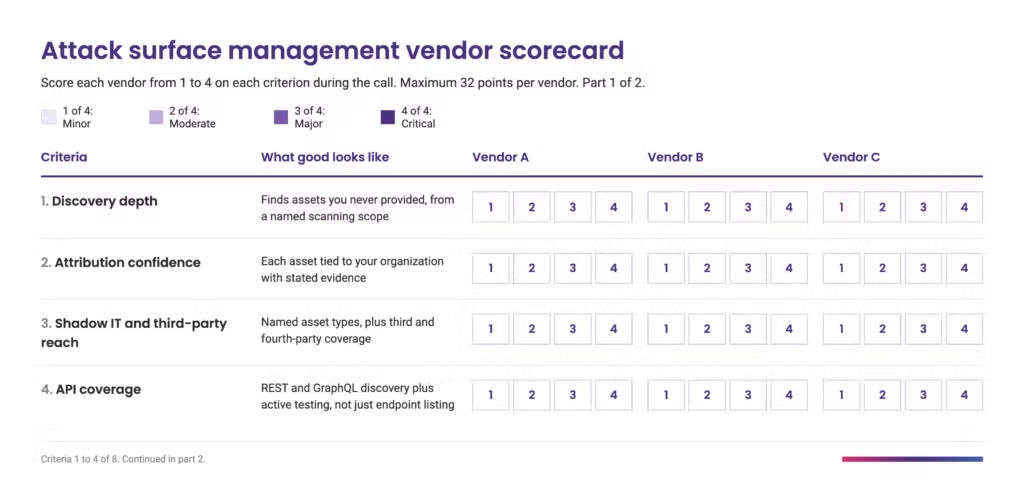
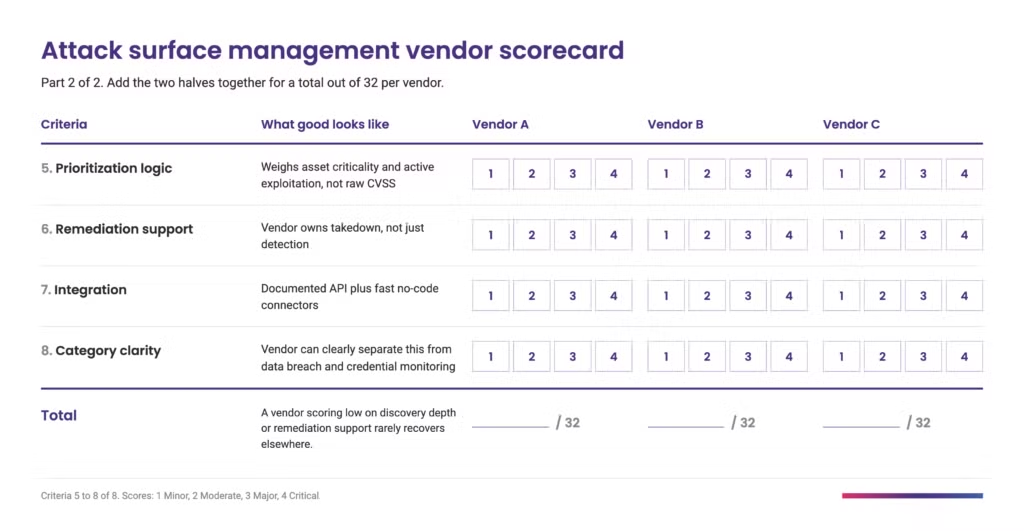
You can score each vendor 1 to 4 (1/4 Minor, 4/4 Critical to your decision) and compare totals across your shortlist when reviewing seriously your top picks.
What this looks like in practice
Sanofi’s Global Head of Cybersecurity, Jean-Yves Poichotte, described what changed in terms of where the detection boundary sits. CybelAngel gave his team “a new border of detection outside of our architecture”, covering partners and suppliers whose security Sanofi cannot, by design, control. That distinction is the point of this checklist. A tool that maps the infrastructure you already administer does the easy half. One that finds the partner-owned appliance, the forgotten subsidiary domain, and the API nobody documented does the part that changes what your team does next.
Your common hesitations, addressed
“We already have a vulnerability scanner.” A scanner tests the assets you point it at. This category finds the assets you would never have pointed it at, which is where the 30% of attacks aimed at shadow assets land. They answer different questions, and having one doesn’t make the other redundant.
“We run an annual penetration test.” A penetration test is scoped, timed, and thorough within its boundaries. Your attack surface changes between tests, and the Bac 2026 leak came from an access point open for a few hours. A test proves what was true in week 12. It says nothing about week 13.
“Our CMDB is accurate.” Then a discovery run during your evaluation confirms it at no cost to you, and you’ve made the case for the tool either way. In practice the first pass almost always returns assets nobody can immediately explain, which is the finding, not a failure of the inventory.
“We don’t have budget allocated this quarter.” The $1.88 million detection-speed gap is the argument to bring to that conversation. A scoped quote costs nothing to obtain and gives you a real number to work with.
“Isn’t this the same as data breach prevention or dark web monitoring?” No. A vendor who can’t explain the difference on a demo call is telling you something useful. See point 7 in the checklist above, or our data breach prevention buyer’s guide and dark web monitoring buyer’s guide for how those categories get evaluated on their own terms.
“We’re already handling third-party risk through our procurement process.” Vendor questionnaires capture what a third party says about their security. This category checks which of their assets are exposed right now, regardless of what the questionnaire said, which is why it pairs naturally with a broader third-party risk program rather than replacing one.
FAQs
Attack Surface Management continuously discovers, attributes, and prioritizes every internet-facing asset tied to your organization, including shadow assets set up outside IT’s knowledge and assets belonging to third parties. It gives you an outside-in view of your exposure: what an attacker sees when they look at your organization, rather than what your inventory says you own.
Vulnerability management tests assets you already know about and have chosen to scan. Attack Surface Management works from the outside in: it discovers assets nobody registered, attributes them to your organization, then assesses their risk. The two are complementary. One widens the scope, the other works within it.
Pricing scales with the breadth of what’s monitored, domains, brands, subsidiaries, and third parties, and with whether active API testing and remediation come included. Vendors that verify attribution and own takedown price higher than tools that only list discovered assets, reflecting the analyst labor behind each report. Treat models that charge per asset discovered with caution.
Yes, and it’s one of the clearest points of differentiation between tools. Strong platforms discover publicly exposed REST and GraphQL endpoints, including rogue, zombie, and shadow APIs that no inventory covers, then use dynamic application security testing to surface OWASP Top 10 risks such as SQL injection and cross-site scripting that passive scanning misses.
The stronger platforms do, and it matters: Verizon’s 2025 DBIR found third-party involvement in breaches rose from 15% to 30% year over year. Ask explicitly whether coverage extends to suppliers and their suppliers, because many tools stop at your own DNS records.
Exposure scales with how much internet-facing infrastructure you run and how many third parties touch it, not with headcount. A small organization running cloud services, SaaS tooling, and a handful of supplier integrations can hold an attack surface it has never fully mapped, and attackers target edge devices exposed by design regardless of company size.
Run this checklist and the scorecard against your shortlist before your next vendor call, and ask the first vendor you speak to for a discovery run against your own domain. Whatever comes back that you can’t immediately explain is the size of the problem you’re buying to solve.
About the author